Learn Japanese
Japanese Culture
Ohanasi Kagawa
Ohanasi Japanese Language School
2023.07.04
Let’s have fun learning the Japanese alphabet! Beginner’s Guide When you want to learn Japanese…
When you want to learn Japanese, the first thing you may encounter is the alphabet. In this article, we will show you how to learn the Japanese alphabet effectively. Starting with the basics of hiragana and katakana, we will explain in detail, including memory techniques and practical application. Read to the end and you will be able to enjoy learning the Japanese alphabet! What is the Japanese alphabet? Let's learn the basics of hiragana and katakana! (How to learn alphabet in Japanese) How to learn alphabet in Japanese First of all, we will explain the basics of the Japanese alphabet. The Japanese alphabet includes hiragana and katakana. Both share the fact that they are derived from Kanji characters, but while hiragana is a broken down form of Kanji, katakana is a character made from a part of Kanji. Characteristically, one sound is fixed to one character. Hiragana and katakana exist as 50 sounds each, corresponding one to one. For example, "a'' in hiragana and "a" in katakana have the same sound. Some of the characters have a dotted or circled sound that becomes a muddled or semi-muddled sound. The difference between hiragana and katakana is that hiragana is the basis of the Japanese language, while katakana is often used for foreign words. In terms of the order of study, hiragana will come first. From here, hiragana and katakana will be explained respectively. Characteristics and basics of hiragana ( Japanese hiragana and katakana guide) Elementary school education Let us explain the characteristics and basics of hiragana. Hiragana is one of the characters used to write the Japanese language. Originally, men such as aristocrats and priests used katakana to write kanji in shorthand, but in the Heian period (794-1185), women and the general public began to write characters as well, and simple characters were needed. Therefore, hiragana developed from a broken form of kanji. Today, hiragana is mainly used in elementary school education and in books for children, and is also utilized along with kanji in daily life. As for the writing style, when writing with a brush, it is expressed in three movements: dots, horizontally, and vertically. However, with the spread of keyboard input, there is a trend where the correct stroke order, stop (tome), upward brushstroke (hane), and sweeping (harai) are becoming less important. Features and basics of katakana (Japanese hiragana and katakana guide) What are the characteristics and basics of katakana? On the other hand, what are the characteristics and basics of katakana? Katakana has its origins in an ancient Japanese writing system called Manyogana. In the Middle Ages, a mixed writing system of kanji and kana became the mainstream, and a system similar to the modern one was established in the Meiji era. Katakana is mainly used to write foreign words, technical terms in science and technology, and product names. It is also sometimes used to express words without kanji characters to enhance readability. All writing styles consist of straight lines and angular curves, and like hiragana, the order and direction of lines is important. However, the writing area is narrower than that of hiragana, and the characters are thinner toward the tips. How to learn the Japanese alphabet: effective practice methods (Japanese writing system basics) ow can we effectively practice the Japanese alphabet? How can we effectively practice the Japanese alphabet? Here are some effective ways to learn hiragana and katakana. - How to Practice Hiragana and Katakana - Mnemonic techniques for learning the Japanese alphabet effectively We will explain each of them in detail. How to practice hiragana and katakana There are some effective ways to practice hiragana and katakana First, here are some effective ways to practice hiragana and katakana. - Use of practice sheets By using hiragana and katakana practice sheets, you can learn how to write them correctly. The practice sheets can also be used for writing and reading practice, so you can broaden the scope of your practice. - Use of Online Resources Online resources can help you practice more efficiently. For example, by using websites and apps for learners of Japanese, you can practice using audio and example sentences. - The importance of repeated practice Hiragana and Katakana practice requires, above all, repetition. By writing and reading the same characters over and over again, you will be able to remember them accurately. It is also important to divide your practice into intervals so that you can increase the amount of practice. By practicing hiragana and katakana with the above perspectives in mind, you will learn how to write and read them accurately. How to memorize Japanese alphabets effectively (how to memorize Japanese alphabets) How to memorize Japanese alphabets Here are some memory techniques to help you memorize hiragana and katakana effectively and enjoyably! - Storytelling method By creating a story and having hiragana and katakana appear in the story, you can easily remember them. For example, by creating a story in which a "red rose" appears, you can memorize hiragana "a", "ka", and "i", and katakana "ba" and "la". - Associative Memory Method For hiragana and katakana, keywords that match the image of each word are set to make them easier to remember. For example, "a" is the color "aoi", "so" is the drink "soda", and so on. - The importance of periodic review Even if you think you have memorized a word, you may forget it over time. In particular, alphabets that are not used very often are rapidly forgotten. Therefore, it is important to review hiragana and katakana regularly to make them stick. For example, reviewing them for 10 minutes every day will help you remember them better in the long run. By being aware of the storytelling method, the association memory method, and the importance of regular review as described above, you can learn hiragana and katakana in a fun and effective way! Practice: Deepen your learning with activities using the Japanese alphabet! (top Japanese language websites) What are top Japanese language websites? From here, let's work on more practical learning! Here are some practical activities using Japanese alphabets. - Let's read Japanese sentences - Let's write your own Japanese sentences! We will explain how to enjoy and deepen your learning through reading and writing. Let's read a Japanese sentence Reading Japanese books... First, let's actually read some Japanese sentences. For reading short sentences, we recommend simple Japanese books, Japanese websites, and Japanese social networking posts. - For simple Japanese books, there are picture books and learning materials for children. They use basic grammar and vocabulary and are rich in pictures and illustrations. - You can read news and blogs on Japanese websites. Some sites are geared toward beginners, and you can improve your reading skills through short articles. - In Japanese social networking sites, you can read Japanese on Twitter and Instagram. You can learn real and colloquial expressions from users' posts and comments. Combined, these methods allow you to learn hiragana and katakana in a practical way. Build your foundation with simple Japanese books and deepen your learning through actual content on websites and social networking sites. By choosing topics that interest you, you will be more motivated to learn. Try writing your own Japanese sentences Try writing your own Japanese sentences! Finally, try writing your own Japanese sentences! You can learn how to use hiragana and katakana practically by writing your own Japanese sentences, such as self-introductions, daily conversations, hobbies and interests, and so on. In self-introductory sentences, you will express your name, hometown, hobbies, etc. in concrete terms. 「こんにちは、私はXXと申します。日本出身で、音楽や旅行が好きです」(Hello, my name is XX. I am from Japan and I like music and traveling.) In everyday conversation, imagine a conversation or scene with a friend and express what you want to say in a sentence. Write greetings, expressions of appreciation, questions and opinions. 「おはよう!今日は予定がある?」(Good morning! Do you have plans today?) or 「昨日の映画、面白かった!」(I enjoyed the movie last night!) We recommend using apps such as Twitter, Instagram, HelloTalk, etc. If you are writing about your hobbies and interests, write about what you like and are interested in. Try using specific expressions such as, 「最近は料理に興味があり、新しいレシピに挑戦しています」(Lately I've been interested in cooking and have been trying out new recipes. ) You may get a reaction from someone! Through this kind of practice, you may actually want to talk to Japanese speakers! Ohanasi Kagawa hosts free online language exchange events on weekends. English and Japanese learners are paired one-on-one and switch the language they speak every 15 minutes. If you are at all interested, please check out the details! In this article, we have explained in detail the basics of hiragana and katakana, the Japanese alphabet, as well as effective learning methods and practical activities. Use these methods to have fun learning the Japanese alphabet! 【For Japanese Learners】 Limited to 10 people Free Consultation & Japanese Lesson We are organizing a free Japanese language consultation & free Japanese lesson for Japanese learners. “Even though I’m studying Japanese, I can’t speak it.” “I don’t know how to study Japanese.” “I’m worried that I can’t see any progress.” Our Japanese Language Learning Counselors would be happy to listen to the concerns of such beginner- or intermediate-level Japanese language learners and advise them on how to learn Japanese and solutions that suit their needs. ※Due to the limited time of our Japanese Language Counselors, we limit the number of participants to 10. We at Ohanasi Kagawa are currently hosting an online Japanese-English language exchange event on weekends.However, we have noticed that there are many people who want to participate but are not confident enough in their Japanese to do so. We are holding this free Japanese language study consultation in the hope that we can help Japanese learners find hints to help them move forward.You can book through the calendar below, and we will send you a link for the free counseling by e-mail.If you’d like to take a Japanese lesson, you can take it for free during this time. Book a free counseling and trial lesson >>>

Ohanasi Kagawa

Learn Japanese
2023.07.03
Boost Your Confidence: Tips for Speaking Japanese Fluently
Are you wondering how to speak Japanese more fluently? Some of you may know basic Japanese phrases but lack the confidence to speak fluently. In this article, we have compiled some of the secrets to improving your Japanese conversation skills. We will introduce tips for Japanese conversation and practical ways to develop your speaking skills. Read to the end and you will know how to improve your Japanese conversation skills! 1. let's learn Japanese conversation tips Here are Japanese conversation tips! From here, we will introduce practical approaches to improving your conversational skills. Here are three key points. Learn situational greetings Master common everyday phrases Learn fillers that connect conversations naturally In the following, we will explain them one by one! 1-1. Learn situational greetings The first tip for Japanese conversation is to learn situational greetings. Greetings are an indispensable part of starting a conversation. Let's learn to use Japanese greetings according to the situation. In this article, we will focus on different greetings depending on the time of day. Example 1: Morning greeting (Ohayo Gozaimasu) “Ohayo gozaimasu" is a greeting used in the morning. The casual shortened version is "Ohayo". Basically, it is said in the morning, but "Ohayo gozaimasu" may be said at any time of the day when someone wakes up from sleep. For example, a person who takes a nap and wakes up at 4:00 p.m. may also be greeted with "Ohayo”. Therefore, it is a relatively versatile greeting. Example 2: Lunchtime Greeting (Konnichiwa) “Konnichiwa" is basically a greeting used during the daytime. It is not tied to a specific time of day and can be used in the greatest number of situations. For example, Internet articles that are read by an unspecified number of people at any given time often begin with “Konnichiwa". It is also considered by many to be a little formal, so it is not often used among friends. Example 3: Evening greeting (Konbanwa) “Konbanwa" is a greeting used at night. Note that this greeting is tied to the evening hours, so it can be used in fewer situations than "Ohayo" or "Konnichiwa”. Like "Konnichiwa”, it is a bit more formal and is often not used with close friends. You will probably hear it on the evening news or nighttime radio. These three are the basic greetings in Japanese. Practice saying them out loud and moving your mouth as many times as you can. To use them at different times and in different situations, you must practice them. 1-2. Mastering common everyday phrases (basic Japanese phrases for speaking) Next, the second tip for Japanese conversation is to master common everyday phrases. In this article, we will introduce three that are essential for communication. Example 1: Thank you (Arigatoo, Arigatoo gozaimasu) "Arigatoo" is used in close relationships, and "Arigatoo gozaimasu" is used when being polite. It is a relationship like the one between "Ohayo" and "Ohayo gozaimasu" mentioned earlier. When something is done for you, doesn't it make you happy just to be able to say thank you? Please try using ""Arigatoo" in various situations. Example 2: Please (Onegaishimasu) “Onegaishimasu" is basically an expression used when requesting something. For example, when handing something over, it can be accompanied by "Kore onegaishimasu," or when meeting someone for the first time, it can be concluded with "Korekara yoroshiku onegaishimasu”. This phrase gives a polite and warm impression, so please try adding it in various situations. Example 3: Excuse me (Sumimasen) “Sumimasen" is the most common of the three. It can be used to express apology, or to express gratitude with a mixture of "I'm sorry" and "thank you". Since these words are very common to hear in daily life, it is recommended to try to guess from the context what meaning they are used for. These three are arguably the most useful phrases when communicating in Japanese. WeI would be happy if you could practice them as your first Japanese phrases, even if you are at an introductory Japanese level. 1-3. Learn fillers that connect conversations naturally One of the things you worry about in Japanese conversation is that you might lose track of the conversation. Here are three fillers to help you keep the conversation moving. Example 1: That's right (Soudesune) “Soudesune" means to affirm what the other person has just said once. It gives the impression of accepting the other person's words for a moment while thinking about what to say next. Of course, "Soudesune, demo" can also be used to express an opposing or supplementary opinion, making it an easy filler to use. Example 2: Well (eeto) “eeto" is a connective when you are thinking about what you are going to say next. It is especially used when you are thinking about the episode you are going to talk about. You are thinking about what you are going to talk about. Example 3: Um (ano) Extending "ano" or "ano~" is another connective word when you are thinking. Unlike "eeto", this is used when you have already decided what you are going to say. This is a filler when you have already decided what you want to say, but are wondering how you should say it. These are things that come up on the spur of the moment if you are a Japanese speaker, but may be difficult for learners to get used to. However, the advantage of fillers is that they convey to the listener that you are thinking at the moment, so please try them little by little. 2. Improve Japanese speaking skills through practice (improve japanese speaking skills) Now that you have practiced the various inputs of Japanese, don't you want to try outputting your Japanese in actual conversations? Here are some ways to improve your Japanese speaking skills through practice. Find a language exchange partner Use Japanese audio and video content Actively create opportunities to speak Japanese These three methods will be explained here! 2-1. Finding a language exchange partner First, we will show you how to find a language exchange partner and how to proceed with an effective language exchange. Example 1: Using an online language exchange site The easiest way to find a language exchange partner is through an online language exchange site. You can connect with Japanese speakers from all over the world, and they have by far the largest number of participants. Some sites are free, so the hurdle is probably low. Example 2: Joining a local Japanese language study group After all, you want to talk face to face! If that is your preference, we recommend joining a local Japanese study group. You can search online for a group near your home that you can easily attend. You can find more details in this article. ↓↓↓ https://ohanasikagawa.com/japanese_language_near_me Example 3. Leverage your social networking connections If you search on Instagram or Facebook using hashtags, you could meet Japanese English learners who are looking for international exchange. While it can be difficult to choose who to partner with in other ways, the advantage of this method is that you can connect with the people you want to connect with. To make the language exchange effective, we recommend that you be aware of active listening and that you take notes while listening. Active listening is to listen proactively rather than passively. Try to listen while thinking about what the other person is trying to say and asking questions that get to the essence of what he or she is trying to say. It is also important to take notes so that you do not forget any new words or phrases you learned during the language exchange. It is good to bring back as much learning as possible. 2-2. Let's use Japanese audio and video content Next, we will explain how to improve your listening and speaking skills by utilizing Japanese audio and video content. Example 1: Watching Japanese TV dramas and movies To learn how the vocabulary and grammar you have learned are used, we recommend watching Japanese dramas and movies. Subtitles can be added, so you can enjoy the level up by watching them with subtitles in your native language at first, then with Japanese subtitles, and finally trying them without subtitles. Example 2: Listening to Japanese podcasts If you want to make the best use of your spare time, Japanese-language podcasts are a good choice. You can study during your commute to work or school, or during your household chores. Even if you have just started learning Japanese, you will learn more quickly if you are familiar with the rhythm and intonation of the Japanese language. Example 3: Follow Japanese language channels on YouTube If you want to experience Japanese while enjoying your hobby, why not follow Japanese language channels on YouTube? Of course, commentary channels for Japanese language learners are great, but if you choose a channel based on your own hobby, such as a live game or fishing channel, it will be easier to continue. 2-3. Proactively create opportunities to speak Japanese Finally, we have compiled a list of activities and ways to create an environment that will increase opportunities to speak Japanese. Example 1: Hold meetings and presentations in Japanese If you have opportunities to use Japanese at school or work, it is effective to hold meetings or presentations in Japanese. This is a chance to practice your formal Japanese, so take advantage of it. Example 2. deepen your interaction with Japanese-speaking friends and colleagues If there are Japanese speakers at your workplace or you have Japanese-speaking friends, it is recommended that you deepen your interactions with them. If you speak to them in Japanese, they will probably be happy to hear from you. Example 3: Participate in Japanese events and communities If you don't have the opportunity to use Japanese at work or school, or if you don't know any Japanese speakers, try participating in Japanese events or communities. With online events, you can access the Japanese community from anywhere in the world. For example, Ohanasi Kagawa hosts online one-on-one language exchange events on weekends. Japanese and English learners switch the language they speak every 15 minutes, creating an environment where they can learn and teach each other. Participation is free, so please check out the details of this event. Summary To improve your Japanese conversation skills, it is important to learn phrases used in daily conversation, practice with language exchange partners, and use audio and video content to improve your listening and speaking skills. Proactively create opportunities to speak Japanese and build your confidence through practice! 【For Japanese Learners】 Limited to 10 people Free Consultation & Japanese Lesson We are organizing a free Japanese language consultation & free Japanese lesson for Japanese learners. “Even though I’m studying Japanese, I can’t speak it.” “I don’t know how to study Japanese.” “I’m worried that I can’t see any progress.” Our Japanese Language Learning Counselors would be happy to listen to the concerns of such beginner- or intermediate-level Japanese language learners and advise them on how to learn Japanese and solutions that suit their needs.※Due to the limited time of our Japanese Language Counselors, we limit the number of participants to 10. We at Ohanasi Kagawa are currently hosting an online Japanese-English language exchange event on weekends.However, we have noticed that there are many people who want to participate but are not confident enough in their Japanese to do so. We are holding this free Japanese language study consultation in the hope that we can help Japanese learners find hints to help them move forward.You can book through the calendar below, and we will send you a link for the free counseling by e-mail.If you’d like to take a Japanese lesson, you can take it for free during this time.Please feel free to book your appointment first!↓↓↓ Book a free counseling and trial lesson >>> Free Japanese study consultation hosted by Ohanasi KagawaWe are an international exchange community that holds free online language exchange events on weekends.More than 2000 people from over 50 countries have participated so far.For more information about Ohanasi Kagawa, please visit
Ohanasi Kagawa

Learn Japanese
Ohanasi Kagawa
2023.07.02
Find the best Japanese course online!
In this article, we will show you how to learn Japanese online and help you find the right course for you. We have compiled a list of recommended online Japanese courses, how to choose an online Japanese course, and effective ways to learn Japanese online. Read to the end and you will find the online Japanese language course that is right for you! Recommended online Japanese course First, we will introduce some popular online Japanese language courses and explain the features and ratings of each. Japanese language courses for beginners Japanese language courses for intermediate and advanced students Let's look at these two categories. Japanese courses for beginners online We will introduce online Japanese courses suitable for beginners and suggest effective learning methods. The timing of your first exposure to Japanese is when you are most likely to fall behind. To prevent this, first check the quality of the course materials and content. If a trial lesson is available, we recommend that you take it. Also the support system and communication method are important. Please check to see if they can answer questions via Zoom, if they only use email or chat, and if you can receive real-time support during your own study time. And it's also important to find out if the cost and learning period are in line with your budget and learning goals. Take time to think about when and at what level you would like to be by. Japanese language courses for intermediate and advanced students This section introduces online Japanese courses suitable for intermediate and advanced learners, and explains how to study and proceed. Once you reach the intermediate or advanced level, you will probably have a better idea of your strengths and weaknesses. If you have skills that you particularly focus on, we recommend courses to strengthen your speaking and listening skills. Also, if you are aiming for a job or higher education using Japanese, it would be a good idea to take a course to learn business Japanese or specialized vocabulary to improve your efficiency. Those who want to enjoy Japanese culture more like a hobby may want to take a course to learn about culture and history. How to choose an online Japanese language course Next, we will introduce some points to consider when choosing an online Japanese language course. Choose a course that meets your goals and objectives Check course evaluations and reviews Check the support system of the online Japanese language course Let's check these three points. Choose a course that meets your goals and objectives The first point to consider is whether you want to focus on conversation skills or reading and writing. The second is whether you want to learn Japanese for work or pleasure, or for everyday conversation. It depends on whether you want to learn specialized vocabulary or vocabulary that is closely related to your daily life. Finally, whether you will study for a short period of time or for a long period of time. This should be considered in conjunction with the level you are aiming for. Check course evaluations and reviews Here are some ways to check ratings and reviews to help you choose a course. First, the easiest place to look is online review and evaluation sites. The advantage is that they are written by an unspecified number of people, so the population is large, but the disadvantage is that you cannot expect much credibility. A little more reliable are reviews on social networking sites and forums. At this time, we recommend looking at personal accounts, which are usually updated frequently. And if you are surrounded by people who are learning Japanese, it is a good idea to get introductions from acquaintances or friends. You can ask them for more details about what they are interested in, so you can gather more information. Check the support system of the online Japanese language course Here are some points to consider when choosing an online Japanese language course with a good support system. First, check if the environment is conducive to asking questions and asking for advice. We recommend courses that have a homeroom teacher system, a buddy system, or a system that allows students to ask questions and seek advice. Another indicator is whether there is an active online community or group activities. If there is a community of learners, you can share learning tips. And you should also look at the level of customer support and follow-up services. Online courses often have systemic problems, so it is important that there is a system in place that can be consulted immediately. Effective ways to learn Japanese online Here are some effective learning methods and habits for studying Japanese online. Get into the habit of practicing on a daily basis Find a learning method that works for you Maintain motivation for learning We will focus on these three points. Establish a daily practice habit First, We would like to suggest a daily practice habit that is effective for learning Japanese. You can either devote your study time to your commute to work or school, or you can set a reminder to set aside some time. It is also effective to use smartphone apps and websites. Why not replace the time you spend on your phone or computer with study time? Keep your study apps and websites on your computer desktop and in a prominent place on your phone's home screen. Moreover, joining a language exchange partner or study group is also a great idea. The advantage of joining these activities is that if you book ahead of time, you can ensure that you will have time to study during that time. Finding the right learning method for you Here are some tips for finding the right fit among the various learning methods. First, spend some time clarifying whether your learning goal is to focus on listening and speaking or reading and writing. If reading books is not your thing, you may find it easier to study by using online materials or videos. For example, videos allow you to study while doing housework. Also, if you prefer to focus on interaction, communicate via chat or email. If you communicate in Japanese, you will feel a sense of accomplishment when you get your message across. How to maintain motivation for learning Here are some ways to stay motivated when learning Japanese online. The most effective way is to set a learning goal or deadline. By clarifying what you want to become and setting a deadline, it will be easier to make a plan. It is also important to keep track of the progress of the plan you have made and check your achievements. Please take time to look back and visualize your growth. If you are not comfortable studying at a desk, try taking time to enjoy learning by experiencing Japanese culture, dramas, and movies. You will find that Japanese is interesting and you will be motivated to learn more! To learn Japanese online, it is important to choose a course that suits you and to adopt an effective learning method. Please refer to the points introduced in this article to find the online Japanese language course that is right for you. Ohanasi Kagawa offers free online language exchange events on weekends. Japanese language learners and English language learners are paired one-on-one and switch the language they speak every 15 minutes so they can teach each other. It's a great chance to make friends online with Japanese who are learning English, so please check it out! Ohanasi Kagawa Website >>> That said, you might still not be confident in your Japanese speaking ability. You're not sure how to study Japanese. For people like that, we are currently offering free Japanese language consultation and free lessons for a limited number of 10 people each month. You don’t know how to study Japanese. If you are interested in taking Japanese lessons to solve what you don’t understand, please feel free to join us.If you are interested, please click the URL or image below. Click here to see more details >>>
Ohanasi Kagawa

Learn Japanese
Ohanasi Kagawa
2023.07.02
Easy even for beginners! Basics of Learning Japanese and Recommended Resources
If you want to learn Japanese, where should you start? In this article, we will introduce the basics of learning Japanese for beginners and recommended resources, perfect for you if you are a fan of anime and manga. Read to the end and you will know how to enjoy learning Japanese! Acquire basic knowledge of Japanese language learning This section explains the basic knowledge you need to know before you start learning Japanese. We will introduce two of them here. Types of characters and how to read them Understanding basic grammar Let's take a look at these two essential points for beginners of Japanese! Types of Characters and How to Read Them Japanese is written in hiragana, katakana, and kanji. We will explain the differences between each and the basics of how to read them. Hiragana is the basic character for the Japanese language. Hiragana is also the first character to be studied when learning Japanese. The basic way to read it is to pronounce it with consonants as well as vowels. The same is true for katakana in terms of reading, but it is often used for foreign words. It's much easier to read than if everything were written in hiragana. And the key point of kanji is that the characters themselves represent a specific meaning, and the meaning can be recognized at a glance. Although it is based on Chinese, it has evolved uniquely in Japan. There are often multiple readings, but it is easier to guess the meaning and reading if you learn the "radical," which is a component of kanji. Understanding Basic Grammar This section provides a brief explanation of important Japanese grammar points for beginners. The structure of Japanese sentences is SOV-type. English is SVO-type, which may seem a little confusing until you get used to it. A particle is attached to the end of a word to supplement the meaning or connect words. It is also important to note that verbs and adjectives change form depending on the word they are attached to. For example, "書く" becomes "書かない" when the negative "ない" is added. Did you notice the one-character change? If you look at another example of how to make a question sentence as one of the basic sentence patterns, you will see that you can add "か" to the end of the sentence." I understand." is "わかります," and "Do you understand?" is "わかりますか" Please enjoy learning about the profound world of Japanese grammar. Recommended Learning Resources for Beginners This section introduces resources and tools recommended for beginners of Japanese language learning. These three are introduced here. Learn the basics with online learning materials Learn practical skills at language exchange events Use apps to learn efficiently All of these methods are easy for beginners to learn, so let's look at them in order! Learn the basics with online materials This section introduces online teaching materials and websites for beginners and explains how to make use of them. First of all, let's learn what kind of grammar there is in Japanese at grammar explanation websites. It is difficult to learn just by reading, so we recommend practicing on free material websites. If you practice repeatedly, you will be able to consolidate your grammar. Furthermore, if you use video materials, you can deepen your understanding by seeing how grammar is used in actual conversations. You can also train your listening skills at the same time. Acquire practical skills at language exchange events This section describes how to participate in language exchange events and how to make the most effective use of them. Language exchange events are held both in person and online. To find online language exchange events, we recommend the app Meetup or Facebook groups. Also, when communicating at events, it is a good idea to do active listening and take notes instead of being passive. By participating regularly, rather than just once, you will get into the habit of learning and improve your learning. Use apps for efficient learning This section introduces and explains how to use Japanese language learning apps for beginners available on smartphones and tablets. Grammar practice apps such as Duolingo are effective for making steady progress in your spare time. How about replacing the time you usually spend casually looking at your smartphone with grammar practice apps? In the case of vocabulary and kanji learning apps, it is also recommended to review them repeatedly over a certain period of time. Even if you think you have learned them once, look back every week or month in order to retain them in your long-term memory. Furthermore, to consolidate these inputs, it is recommended to practice your practical skills with a conversation practice application. You can get feedback during the interaction, and the sense of accomplishment when you get the message across will help keep you motivated. Even beginners who are interested in Japanese from anime and manga can learn Japanese while having fun by acquiring basic knowledge of the language and using effective resources. Let's make good use of online materials, language exchange events, and apps to continue learning Japanese. Ohanasi Kagawa offers free online language exchange events on weekends. Japanese and English learners are paired one-on-one and switch the language they speak every 15 minutes, so even beginners can practice their conversation skills. We have various rules in place to ensure that everyone can enjoy the event comfortably, so even those new to online events can participate with confidence. This is a great chance to make friends online with Japanese people who are learning English, so please check it out! Ohanasi Kagawa Website >>> That said, you might still not be confident in your Japanese speaking ability. You’re not sure how to study Japanese. For people like that, we are currently offering free Japanese language consultation and free lessons for a limited number of 10 people each month.You don’t know how to study Japanese. If you are interested in taking Japanese lessons to solve what you don’t understand, please feel free to join us.If you are interested, please click the URL or image below. Click here to see more details >>>
Ohanasi Kagawa

Learn Japanese
Ohanasi Kagawa
2023.07.01
Master Japanese Fast! Boost Your Japanese Skills with Efficient Learning Methods
In this article, we will show you how to learn Japanese in a short period of time by using efficient learning methods. Let's improve your Japanese language skills by using accelerated Learning methods and Japanese language hacks. Read to the end and you will be able to learn Japanese efficiently! 1. Utilizing Accelerated Japanese Learning Methods In this section, we will introduce effective methods for accelerating your Japanese language learning. The three methods we will be discussing are - Spacing Effect - TPR (Total Physical Response) - Shadowing By utilizing these methods, you can improve your Japanese language skills in a short period of time. 1-1. Learning with the Spacing Effect The spacing effect is a phenomenon in which learning at regular intervals enhances memory retention. Let's learn Japanese vocabulary and grammar efficiently by using this effect. For example, it is recommended to use Anki, which allows you to create your own vocabulary cards with questions and answers, or to create a study schedule on a calendar. It is also a good idea to adjust the timing of your review. 1-2. Japanese Learning with TPR (Total Physical Response) TPR is a learning method that combines physical actions and is effective for memorizing words and phrases. By learning Japanese while actually performing the actions, it is easier to retain them in memory. For example, some ideas include memorizing verbs such as "stand" and "sit" while actually performing the actions that match the meaning of the verb, or memorizing nouns by using actual objects in your home. If you have a practice partner, you can also try role-playing that incorporates gestures. 1-3. Japanese Shadowing Technique The shadowing technique is a method of listening to Japanese audio or video and practicing aloud at the same time. This method is effective in improving both listening and pronunciation skills at the same time. Shadowing with podcasts or audio materials is recommended as an easy way to learn. If you want to study while having fun, you can practice shadowing with Japanese movies and dramas. You can also ask your online conversation partner to "shadow" you if you have someone you can ask. 2. Mastering Japanese Language Hacks In this section, we will introduce some hacks and techniques to help you learn Japanese more efficiently. In this article, we summarize the following three. - Using Kanji radicals - Understanding the phonetic alphabet - Learning Sentence Patterns By utilizing these Japanese language hacks, you will enjoy learning Japanese! 2-1. Learning Kanji with Radicals Radicals are the building blocks of Kanji. By learning these, you can learn the meaning and reading of kanji efficiently. Let's combine radicals when learning kanji. Start by learning the shape and meaning of the basic radicals. After that, you need to practice finding the radicals and guessing the meaning of the kanji. Once you know the radicals, you can create and learn the story of the kanji. 2-2. Understanding Japanese Sound Changes Japanese sound changes are phonological phenomena related to word and grammatical changes. By understanding sound changes, you will be able to learn Japanese pronunciation and grammar more efficiently. First, there are continuous phonetic stanzas, such as when "aruku" becomes "aruite" instead of "arukite". Second, you should also know sequential voicing (rendaku), which combines the (hana) and (koe) forms to become hana-goe. By learning the rules and exceptions to the phonetic rules, you will be able to guess when you encounter unfamiliar words. 2-3. Learning Japanese Sentence Patterns By learning Japanese Sentence Patterns, you can learn grammar efficiently. Let's master the basic sentence patterns and learn to use them in daily conversation. First, it is essential to memorize the five basic sentence patterns of Japanese. To firmly establish what you have memorized, repeatedly solve practice problems using the sentence patterns. As an application, you will gain confidence if you can practice to the point of utilizing the sentence patterns in your own daily conversation. 3. Utilizing Intensive Japanese Courses In this section, we will show you how to improve your Japanese language skills in a short period of time by taking advantage of intensive Japanese courses. In this article, we will focus on the following three points. - How to choose an online intensive Japanese course - How to study in an intensive Japanese language course - Follow-up after the Intensive Japanese Language Course Let's maximize your learning in the Intensive Japanese Language Course by following the points. 3-1. Choosing an Online Intensive Japanese Course There are many online intensive Japanese language courses offered, but it is important to choose the right course for you. Here are some points to help you choose the right one. The most important thing is to make sure that the course content and goals match your needs. If you feel it is a good fit, check the reputation of the course by referring to reviews and ratings. If a free trial lesson is available, be sure to attend and check the atmosphere. 3-2. Studying in an Intensive Japanese Course This section introduces learning methods and tips for effective learning in an Intensive Japanese Course. By adopting effective study methods, you will improve your Japanese language skills in a short period of time. First, it is essential to manage your schedule and establish a study habit. Let's make learning a routine and integrate it into your daily life. Of course, it is also essential to accumulate independent study outside of class. Also, make active use of the feedback you receive in the course by keeping a record of it and reflecting on it regularly. 3-3. Follow-up After an Intensive Japanese Course Follow-up after an Intensive Japanese Course is necessary to consolidate what you have learned. Here we will introduce some effective follow-up methods. Reviewing and practicing what you have learned is essential for follow-up. However, there are limits to what you can do alone, so we recommend joining a Japanese language learning community or finding an online language exchange partner. For example, Ohanasi Kagawa hosts free online language exchange events on weekends. Japanese learners and English learners are paired one-on-one and practice switching the language they speak for 15 minutes at a time. Since they have time to output to each other, they can practice without hesitation rather than being taught one way or the other. You can build a relationship where you can teach each other, so if you want to make friends in Japan, please check out the details of this program. Ohanasi Kagawa Website >>> In this article, we have introduced the shadowing method, Japanese language hacks, and the use of intensive Japanese language courses as efficient ways to learn Japanese. If you can successfully incorporate these methods into your life, you can improve your Japanese language skills in a short time. Find the learning method or course that suits you best and continue to enjoy learning Japanese! That said, you might still not be confident in your Japanese speaking ability. You’re not sure how to study Japanese. For people like that, we are currently offering free Japanese language consultation and free lessons for a limited number of 10 people each month.You don’t know how to study Japanese. If you are interested in taking Japanese lessons to solve what you don’t understand, please feel free to join us.If you are interested, please click the URL or image below. Click here to see more details >>>
Ohanasi Kagawa

Learn Japanese
Ohanasi Kagawa
2023.07.01
Learn Japanese effectively in a way that suits you! (Learn Japanese near me)
If you want to learn Japanese, are you wondering what kind of learning method is best for you? In this article, we will introduce you to various means of learning Japanese in a way that suits you best. Read to the end and you will find an effective way to learn Japanese that is perfect for you! Take advantage of local classes, language exchange events, and online tutoring to find the learning method that works best for you. Join local Japanese classes First, here is a summary of how to join a local Japanese class. The two main points are as follows. ・How to find a class ・Types of classes and how to choose one The following is a step-by-step guide to these points. Let's join a Japanese language class near your home and make effective progress in your Japanese language study. How to find a class In this section, we will show you how to find a Japanese language class and the key points to consider when choosing one. There are the following types of Japanese language classes. ・Local community centers ・Language schools The main difference between the two is the purpose of the class. Local community centers often have the purpose of deepening the knowledge of Japanese language, a part of Japanese culture, or international exchange through Japanese language. For this reason, activities are offered on a volunteer basis, and classes are offered in a wide variety of genres, including Japanese culture of food, clothing, and shelter. If tuition is paid, it is very inexpensive. Language schools, on the other hand, operate as a corporation, so you will have to pay somewhat higher tuition fees. By learning Japanese, students aim to work in Japanese or enter a Japanese university after graduation. Therefore, the instruction is often more authentic and systematic than the classes offered at local community centers. Thus, you need to pay attention to the purpose of study, budget, and schedule when choosing the right one. Types of classes and how to choose Once you have decided whether to study at a local community center or at a language school, let's look at the types of classes and how to choose one. First, here are some pointers on choosing classes at different levels, such as beginner, intermediate, and advanced. No matter how much you read the class descriptions, you may feel uneasy if you are not sure which class you fit into. If you are a complete beginner, you will start from the introductory class, but the intermediate and advanced levels often vary greatly from school to school and class to class. If you find a class that interests you, you may feel more comfortable if you inquire about it and observe a class. Furthermore, class types are also divided into group classes and individual tutoring. The advantages and disadvantages are as follows. ・Group classes Relatively inexpensive You can learn from what your classmates say Students can make friends to learn with. Students can encourage and compete with each other Can be difficult for those who are not good at speaking up in front of others You may not always get along with your classmates The class atmosphere depends on the motivation of classmates. ・Private lessons Relatively expensive Students can speak up and ask questions at their own timing You can study at your own pace You can focus on yourself without comparing yourself with others Can be difficult for those who have difficulty staying motivated when working alone May not be suitable for those who want to have friends and rivals Which one seems better suited for you? Please consider the advantages and disadvantages and your budget while choosing the class. Participate in Japanese language exchange events (Japanese language meetups) Next, we will introduce you to language exchange events where you can not only learn Japanese, but also meet new people. Here are two key points. ・How to find an event ・How to find an event Let's take a look at some of the advantages of language exchange events. How to find an event First, here are some tips on how to find a Japanese language exchange event and what to expect when attending. Here are two ways to find a language exchange event. ・Meetup.com ・Facebook Groups Meetup is a platform service that allows you to make connections through hobbies and learning. It is a great way to meet neighbors who are learning Japanese, which may motivate you to learn more. You can also find language exchange events in Facebook groups as well. Once you get used to it, you can be on the side of creating your own group, which is a great way for those who like community. When participating in these events, you should be careful to make sure that the event operator is clearly stated, that the participation fee is not unreasonable, that the event has a good word-of-mouth and reputation, and that the event rules are clear. To avoid trouble, check carefully in advance. Tips at the event Now, let's look at some tips for actually learning Japanese effectively at language exchange events and how to build good relationships. The following two are probably the most important ones that many of you focus on in situations other than learning Japanese. ・Active listening ・Taking notes Traditionally, speaking and writing are considered outputs, while listening and reading are considered inputs, but in recent years active listening has been gaining attention.This is achieved when the listener proactively tries to grasp what the speaker is trying to say. Especially in Japanese language study, it is important to try to understand the essence of what the speaker is trying to say, rather than just letting the conversation flow from right to left. One effective way to achieve this is to take notes. Of course, it would be nice if you could come back with notes on words and grammar that you are exposed to for the first time. Use online Japanese tutors Finally, we will show you how to find online Japanese tutors and learn Japanese effectively through tutoring. The two main points are as follows. ・How to find an online tutor ・How to choose an online tutor Please refer to the following page for a summary of what online language learning services are like. How to find an online tutor First, we introduce the platforms and methods for finding Japanese language tutors online. Here are two of the recommended methods. ・Using Italki ・Using Preply Italki is an online language learning service for more than 100 languages, and since the system is to pay for each 60-minute lesson, it is recommended for those who are not sure if they can find time to study with a monthly subscription. It is also a safe place to start for those who want to try it out for the first time. The system is divided into professional instructors and tutors, so you can choose the tutor that best suits your needs. Preply is another online language learning service. Preply is another online language learning service that offers a trial lesson to see if the tutor is a good fit for you, and after your trial lesson, you can purchase a course that includes multiple lessons, which is suitable for those who want to continue having lessons with the same tutor. Did get an idea of which one might be right for you? Let's learn about the characteristics of each and choose the method that best fits your study plan. How to choose a tutor In addition, here are some points to consider when choosing the right online Japanese language tutor for you. The two points are as follows. ・Teaching experience ・Student reviews First, regarding teaching experience, check what kind of educational institution they have been teaching at and for how many years. If they also include their educational background and qualifications in Japanese language education, it shows that they have specialized in Japanese language education. The profile often includes information about the type of classes they aim to teach, so please check to see if it matches what you are aiming for. And if you can see reviews by students, please refer to them as well. Even if there is no information on educational background or qualifications, if the school has a very good reputation, you can expect to find it. If you can confirm what kind of teaching style is used and what parts of the course made a good impression, you can apply for the course with confidence. Conclusion In this way, you can learn Japanese in a way that suits you best, whether it is through local Japanese language classes, Japanese language exchange events, or online tutoring. By trying different means and finding the best learning method, you will be able to learn Japanese effectively. If you are interested in language exchange events, among others, we recommend Ohanasi Kagawa, which holds free online language exchange events on weekends. English and Japanese learners are paired one-on-one and change the language they speak every 15 minutes, so they can focus on their output without hesitation. Even though it is a free event, the rules have been established to ensure a safe and enjoyable experience, so don't worry if this is your first time participating in an online event. Please check out the details of this event. Ohanasi Kagawa Website >>> That said, you might still not be confident in your Japanese speaking ability. You’re not sure how to study Japanese. For people like that, we are currently offering free Japanese language consultation and free lessons for a limited number of 10 people each month.You don’t know how to study Japanese. If you are interested in taking Japanese lessons to solve what you don’t understand, please feel free to join us.If you are interested, please click the URL or image below. Click here to see more details >>>
Ohanasi Kagawa
Learn Japanese
Japanese Culture
Ohanasi Kagawa
Ohanasi Japanese Language School
2023.07.01
【ADVICE to Japanese learners】Vol.1/ Do you lend your ears to Japanese friends?
Do you have some Japanese friends? If you do, I believe that today's topic is useful when you talk with them !! Hi!! I'm Satomi in Ohanasi Japanese Language School.Today, I'll teach you about what Japanese people feel is important in the conversation. Do you listen attentively to what your friends saying? I wonder if you listen attentively when you talk with your friends. You might think, “Of course, I always listen attentively.” Do you know that there are 2 kinds of words for “listen” in Japanese? They are “聞く” and “聴く”. I think you can communicate better with Japanese people if you understand the difference in their meanings. 【聞】and【聴】 First, there are 【門】and【耳】in the Kanji of 【聞】. On the other hand, there are 【耳】,【目】,and【心】in 【聴】, right? The difference between 【聞】and 【聴】is whether if there are 【目】【心】.(【目】means “eyes”.【心】means “heart”) In other words, 【聴く】means “listening with your eyes and heart”. It’s interesting, isn’t it? Do you know the word 【傾聴(けいちょう)】? For Japanese people it is very important. What does “listening with your eyes and heart” mean? People say, it’s important to listen attentively to others when you talk with others.(It means 【傾聴】). What’s 【傾聴】? The Kanji 【傾】in 【傾聴】is called 「かたむける」.「かたむける」means “to focus on certain things” too. That’s why, 【傾聴】means “listening to what the other person is saying mindfully”. The purpose of 【傾聴】is to understand the other person well while focusing on what he/she wants to say . You can make better relationships not only in special situations, but in daily situations, if you can do 【傾聴】. For this reason, many Japanese people are learning 【傾聴】. I'll teach you 5 points of 【傾聴】 that you can use easily from today in the next blog^^ このブログを日本語でよむ
Ohanasi Kagawa
Learn Japanese
Ohanasi Kagawa
Ohanasi Japanese Language School
2023.06.24
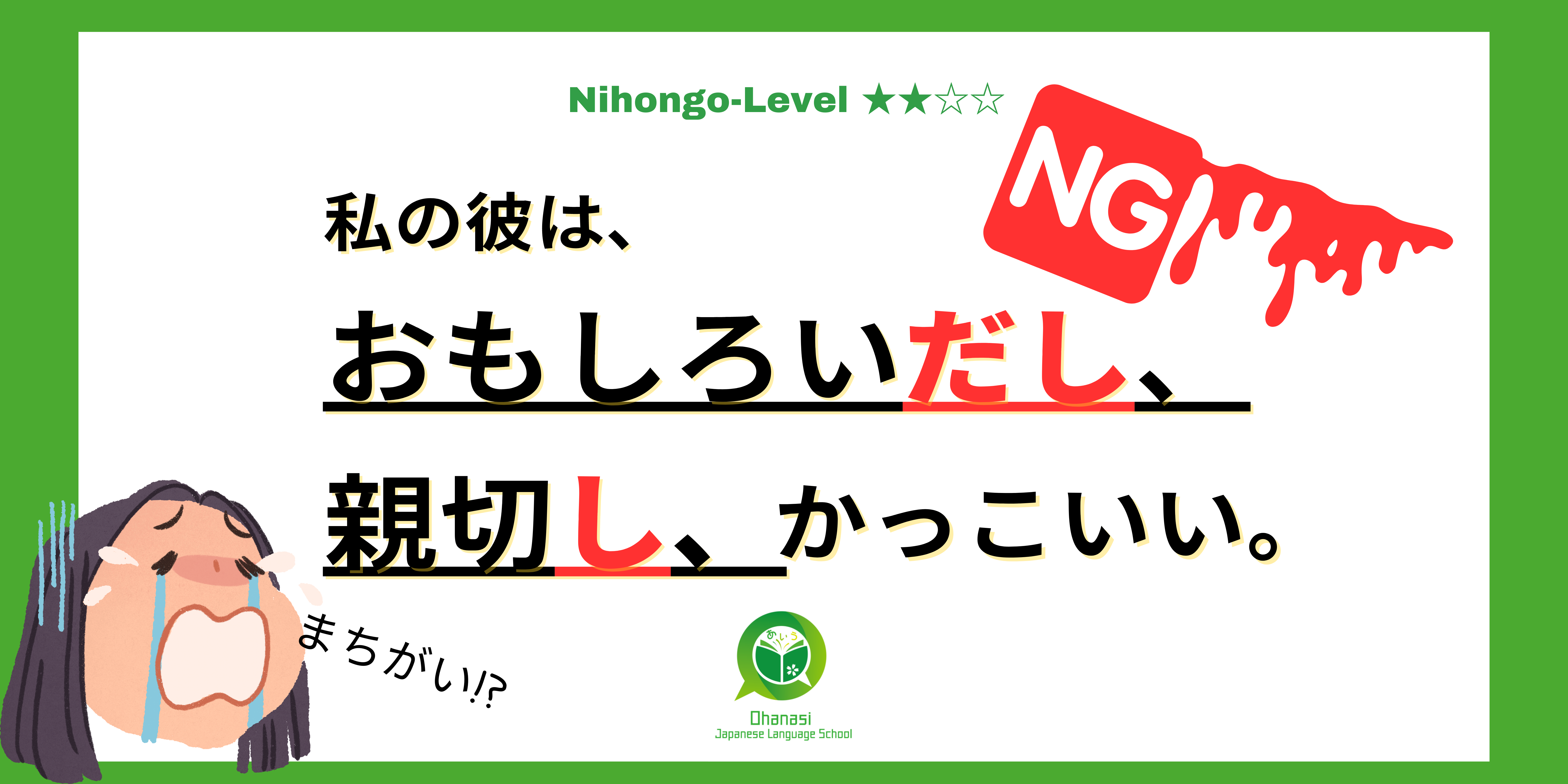
【Nihongo-Level ★★☆☆】Do you know how to use”~し、~し” correctly?
I think... many Japanese learners cannot use this grammar correctly . How about you? Hi!! I'm Satomi in Ohanasi Japanese Language School.Let's practice this grammar together★ QUIZ1:Are these sentences correct, or in correct? 1.私の彼、おもしろいだし、親切し、、、もう最高なの! WATASHINO KARE, OMOSHIROIDASHI,SHINSETSUDASHI,MOU SAIKOU NANO!! My boyfriend is so fun , kind and wonderful !! 2.A「ねぇね。マック行こうよ!安いし早いしおいしいし!」 "NE-NE. MAKKU IKOUYO!! YASUISHI HAYAISHI OISHIISHI !!" Hey, let's go to McDonald's !! It's reasonable, fast, and delicious !! B「えぇ~?今日もまた行くの?昨日も行ったじゃん…」 "EE-, KYO-MO MATA IKUNO? KINOUMO ITTAJAN..." Seriously? We go there today too? We went there yesterday... 3.母「あなた!昨日、コンビニで万引きしたっていう話、本当!?」 "ANATA !! KINOU, KONBINIDE MANBIKISHITA TTEIUHANASHI, HONTOU!?" I heard that you stole something in a convenience store, right?" 息子「は?オレは何もしてないだし、知らないだし、関係ないだよ!」 "HA? OREHA NANIMO SHITENAIDASHI, SHIRANAIDASHI,KANKEINAIDAYO!"Are you kidding me? I didn't do anything, know anything, and have nothing to do it. QUIZ1:Answer 1. ✕ 2.〇3. ✕ 1.私の彼、おもしろいし、親切だし、、、もう最高なの! 2.A「ねぇね。マック行こうよ!安いし早いしおいしいし!」 B「えぇ~今日もまた行くの?昨日も行ったじゃん…」 3.母「あなた!昨日、コンビニで万引きしたっていう話、本当!?」 息子「は?オレは何もしてないし、知らないし、関係ないよ!」 Did you know everything?Let's practice the grammar from now on !! How to use this grammar? ★POINT★名詞(Noun)& な形容詞(なadjective)⇒~だし ★POINT★There are some conjugation in verb.*It's better to match the form in one sentence.ex ✕知っていますし、分かるし… 〇知っていますし、分かっていますし… QUIZ2:Practice 1.このスカートは色が( )、好きなデザインだし…買います!aあるし bあかるいだし cきれいし dきれいだし 2.A「どうしてこの会社に入ったんですか。」 B「残業も( )、ボーナスも多いですし、それに実家から近いですから。」aなかったし bないですし cあるだし dありますし※"~し~し、それに…" is often used when it comes to describing a reason. 3.私の祖父は、タバコをたくさん( )、お酒をたくさん( )、健康が心配だ。a吸うし/飲むし b吸いますし/飲むし c吸わないし/飲まないし d吸ったし/飲んでいるし QUIZ2:Answer 1.このスカートは色が( dきれいだし )、好きなデザインだし…買います! 2.A「どうしてこの会社に入ったんですか。」 B「残業も( bないですし )、ボーナスも多いですし、それに実家から近いですから。」 3.私の祖父は、タバコをたくさん( a吸うし )、お酒をたくさん( a飲むし )、健康が心配だ。 You did it !!I hope you can use this grammar in daily conversation next^^ このブログを日本語でよむ
Ohanasi Kagawa

Learn Japanese
Ohanasi Kagawa
2023.06.05
Conversation Techniques and Resources (Learn to Speak Japanese Free)
Do you want to learn Japanese but are wondering if you can learn it for free first? In this article, we will introduce you to some free Japanese conversation methods and resources that you may want to know about before you travel. First, we explain the free Japanese conversation resources, and then we summarize how you can continue learning at your own pace. Read to the end and you will be able to continue learning free Japanese in your own way! Take advantage of free Japanese conversation resources (Free Japanese Speaking Resources) First, we will introduce some free Japanese speaking resources and explain how to make use of them. These are the two we will introduce here. Learn basic conversational phrases on the website Improve your listening skills with videos Let's take a look at each of them! Learn basic conversational phrases on the website First, we will introduce websites that provide Japanese conversation phrases for beginners and explain how to learn them effectively. For example, the website of Japan's Agency for Cultural Affairs has compiled a list of greetings that can be used in a variety of situations. https://tsunagarujp.bunka.go.jp/level02/b09 This site, also from the Agency for Cultural Affairs, has a similar collection of phrases that can be used in everyday conversation. There are many items, so you can learn from the ones you are interested in. https://tsunagarujp.bunka.go.jp/level00?lang_id=EN Also, on this NHK (Japan Broadcasting Corporation) site, many lessons are available for situations in which you are traveling to Japan. https://www.nhk.or.jp/lesson/en/lessons/ You can use these sites to learn basic conversational phrases. Improve your listening skills with videos Next, we will explain how to improve your listening skills by using videos to learn Japanese conversation. The most popular way to find Japanese conversation videos is on YouTube. You can listen to real conversations, and many of them have subtitles. You can also find video materials on the websites of the above-mentioned Agency for Cultural Affairs and NHK. These are attractive in that they are designed for learning Japanese and are put together in an easy-to-understand manner. It is a good idea to first watch videos on websites for learning Japanese, and then watch YouTube, dramas, and animations to be exposed to live conversations. By watching these repeatedly, your ears will become accustomed to them, and you will be able to hear sounds that you did not hear at first. Practice Japanese conversation for free Next, we would like to introduce you to a couple of ways you can practice Japanese conversation for free. Here are two of them. Find a free online chat partner Get a chance to actually speak at a language exchange event These are two ways to practice speaking Japanese. Finding a free online chat partner The first way to find free Japanese chat partners online is to find Japanese study buddies on social networking sites and forums. You can use hashtags like "I'm studying Japanese." Second, you can use chat apps to practice your Japanese, such as Hellotalk, a language exchange app that has a chat function. Third, you can join online groups such as Facebook Groups or Meetup, where you can chat with people in Japanese. We would like to increase our exposure to the Japanese language by keeping in touch with our online connections. Get a chance to actually speak at language exchange events (Japanese Language Exchange Platforms) Next, we will show you how to practice speaking Japanese by participating in language exchange events. First, you can participate in online language exchange events. Online events are flexible in terms of location, date, and time, so you can participate from anywhere in the world at any time. On the other hand, if you are looking for a local language exchange event, we recommend that you try using local community centers. You will have a chance to be introduced to other events related to international exchange. The benefit you can get from a language exchange event is that you can have a relationship where you teach and learn from each other, and you can output without hesitation. Since you can relate to each other on a flatter level than in a classroom, you will probably get to know each other like friends. Find ways to learn continuously at your own pace. Here are some tips on how to take advantage of free resources and find a way to learn Japanese that works for you. Here are two key points Keep yourself motivated by setting goals Make it a habit to learn effectively Let's learn how to keep learning Japanese! Keep yourself motivated by setting goals First, we will show you how to set goals and a study plan to help you achieve them. To stay motivated, it is important to set short-term and long-term goals. To do this, first think about your ultimate goal and when you want to achieve it. Once you have decided, break them down into yearly, half-yearly, three-monthly, monthly, and finally weekly or daily goals. To create a study plan that meets your goals, it is important to break down your goals into the elements necessary to achieve them. For example, pass the JLPT Level 3 in two years! you need to think about what you need to study in order to pass the test, and set goals for each element, such as grammar, vocabulary, listening, and so on. If you achieve your goals, congratulate yourself by rewarding yourself. By even thinking about your reward list in advance, it will motivate you to study. Make learning effective by making it a habit Next, we will show you how to make studying Japanese a habit and give you some tips for effective learning. The best way to find a study time that you can continue every day is to set it up with something you are already in the habit of doing. For example, listen to a Japanese podcast while taking a bath, memorize three words while brushing your teeth, or play a Japanese YouTube video while washing dishes. Be sure to set it up with something you have to do in your life. This way, you can take advantage of free resources and continue to learn. In addition, keeping a record of your learning will increase your motivation. When you summarize what you've done today in a notebook or app, you can look back on your progress and feel a sense of accomplishment. Try using your favorite notebook or a nicely designed app so that you can enjoy keeping track. We have introduced a number of free resources to help you become conversant in Japanese. Make good use of websites, videos, online chats, and language exchange events to find a learning method that works for you and keeps you going! If you are not sure which one to start with, we recommend Ohanasi Kagawa, which hosts free online language exchange events on weekends. English learners and Japanese learners are paired one-on-one and switch the language they speak for 15 minutes at a time. The rules are designed to make it easy for those new to online events to participate, so please check out the details of this event. Ohanasi Kagawa Website >>> That said, you might still not be confident in your Japanese speaking ability. You’re not sure how to study Japanese. For people like that, we are currently offering free Japanese language consultation and free lessons for a limited number of 10 people each month.You don’t know how to study Japanese. If you are interested in taking Japanese lessons to solve what you don’t understand, please feel free to join us.If you are interested, please click the URL or image below. Click here to see more details >>>
Ohanasi Kagawa

Learn Japanese
Ohanasi Kagawa
2023.06.05
How to Effectively Increase Your Japanese Vocabulary: Thematic Lists and Kanji Acquisition
Memorizing vocabulary is an unavoidable part of learning Japanese. Many people may find it difficult or painful to memorize vocabulary. In this article, we will show beginners and intermediate learners how to learn Japanese vocabulary effectively by learning thematic lists and kanji. Read to the end and you will enjoy learning Japanese vocabulary! Vocabulary list by theme for easy learning First, let's look at how to learn vocabulary by theme. Themes refer to situations such as daily life, work/business, and travel/leisure. When you study vocabulary classified by theme, you can connect words that appear in those situations and remember them, which makes learning more efficient. Here is the actual list of vocabulary words by theme. Daily Life Vocabulary First, we have compiled a list of common daily life vocabulary related to food, transportation, and shopping. Just by knowing this vocabulary, you will probably be able to catch more words when you watch dramas, movies, and anime. English translations and example sentences are also included. Food Vocabulary りんご (ringo) - apple りんごはあかいです。 The apple is red. さかな (sakana) - fish さかなりょうりをたべました。 I ate fish dishes. にく (niku) - meat にくとさかなどちらがすきですか? Which do you like better, meat or fish? たまご (tamago) - egg わたしはたまごアレルギーです。 I am allergic to eggs. みず (mizu) - water みずをください。 Please give me some water. パン (pan) - bread ごはんよりパンがすきです。 I prefer bread to rice. 野菜 (yasai) - vegetables 野菜がきらいです。 I don't like vegetables. 果物 (kudamono) - fruits 果物をかってきてください。Please bring me some fruit. お茶 (ocha) - tea お茶がのみたいです。 I would like to drink tea. Transportation Vocabulary 電車 (densha) - train どの電車にのればいいですか? Which train should I take? バス (basu) - bus バスていはどこですか? Where is the bus stop? 自転車 (jitensha) - bicycle 自転車をかりたいです I would like to borrow a bicycle. 車 (kuruma) - car 車でいけますか? Can I drive a car? 飛行機 (hikouki)) - airplane 飛行機だといくらかかりますか? How much does it cost by airplane? 地下鉄 (chikatetsu) - subway ちかてつでなんぷんかかりますか? How long does it take by subway? タクシー (takushii) - taxi タクシーのりばをおしえてください。Please tell me where I can find the taxi stand. 船 (fune) - boat 船にのりたいです。 I'd like to take a boat. 駅 (eki) - station 駅まであるいていけますか? Can I walk to the station? 停留所 (teiryuujou) - bus stop 停留所がみつかりません。I can't find a bus stop. Work and Business Vocabulary Next, we have compiled a list of essential vocabulary for work and business situations. These are vocabulary commonly used in an office and the names of jobs. If you want to learn business Japanese efficiently, please refer to this list as a first step. Office Terms 机 (tsukue) - desk 机をうごかしてもいいですか? May I move the desk? 椅子 (isu) - chair 椅子がひとつたりません。 There is one chair missing. コンピューター (konpyuutaa) - computer コンピューターがつきません。 The computer isn’t working. 電話 (denwa) - telephone わたしが電話をとります。 I will pick up the phone. 会議 (kaigi) - meeting あしたのごごに会議があります。 There’s a meeting tomorrow afternoon. 文房具 (bunbougu) - stationery 文房具をかってきます。 I will get some stationery. プリンター (purintaa) - printer プリンターはどこにありますか? Where is the printer? ファイル (fairu) - file なにいろのファイルですか? What color is the file? ペン (pen) - pen ペンをおかりしてもいいですか? May I borrow a pen? 紙 (kami) - paper 紙でていしゅつしてください。 Please hand it in by paper. Job Titles and Expressions 社員 (shain) - employee あのひともうちの社員です。That person is our employee. 上司 (joushi) - boss 上司とめんだんしました。 I had a meeting with my boss. 部下 (buka) - subordinate 部下にしごとをまかせました。 I entrusted the job to my subordinate. 先生 (sensei) - teacher ちゅうがっこうの先生をしています。 I am a teacher at a middle school. 医者 (isha) - doctor たいちょうがわるいので、医者にみてもらいます。 I have to see a doctor because I don’t feel well. エンジニア (enjinia) - engineer ことしからエンジニアになりました。 I have been an engineer since this year. デザイナー (dezainaa) それはデザイナーにおねがいしてください。 Please ask a designer to do that. 受付 (uketsuke) - receptionist 受付にきいてみます。 I'll ask the receptionist. セールスマン (seerusuman) - salesman セールスマンがきています。 The salesman is here. マネージャー (maneejaa) - manager マネージャーとはなしてきてください。 Please go talk to the manager. Travel and Leisure Vocabulary Here is some travel and leisure vocabulary related to sightseeing, accommodations, and popular sightseeing activities. If you learn this, it will be useful when you travel to Japan! We've also included some useful phrases so you can practice! Sightseeing Vocabulary 観光地 (kankouchi) - tourist spot おんせんがゆうめいな観光地はどこですか? Which sightseeing spot is famous for its hot spring? 美術館 (bijutsukan) - art museum 美術館までバスでいけますか? Can I take a bus to the museum? 寺院 (jiin) - temple 寺院はちかくにありますか? Is there a temple nearby? 神社 (jinja) - shrine 神社のおみせはなんじまでですか? What time does the stop at the shrine close at? 公園 (kouen) - park 公園でごはんをたべてもいいですか? Can I eat in the park? 動物園 (dobutsuen) - zoo 動物園のチケットはいくらですか? How much is a ticket for the zoo? 展望台 (tenboudai) - observatory 展望台はなんじからですか? What time does the observatory start? アトラクション (atorakushon) - attraction アトラクションはなんさいからのれますか? What is the minimum age to ride the attraction? 水族館 (suizokukan) - aquarium 水族館でショーがみられますか? Can I see a show at the aquarium? 歴史博物館 (rekishi hakubutsukan) - history museum 歴史博物館はあしたあいていますか? Is the history museum open tomorrow? Accommodation and Activity Vocabulary ホテル (hoteru) - hotel ホテルはなんじにチェックアウトですか? What time do you check out of your hotel? 旅館 (ryokan) - traditional Japanese inn 旅館にろてんぶろがありますか? Does the ryokan have an outdoor bath? ホステル (hosuteru) - hostel これはホステルですか? Is this a hostel? ゲストハウス (gesutohausu) - guesthouse ゲストハウスにいちばんちかいコンビニはどこですか? Where is the nearest convenience store to the guesthouse? 観光 (kankou) - sightseeing 観光にきました。 I'm here for sightseeing. ハイキング (haikingu) - hiking ハイキングようのくつがありません。 I don't have hiking shoes. ショッピング (shoppingu) - shopping ショッピングできるばしょがありますか? Is there a place where I can go shopping? スキー (sukii) - skiing スキーはなんがつからできますか? From what month can we start skiing? 温泉 (onsen) - hot spring 温泉にはいりたいです。 I would like to try hot spring. スポーツ (supootsu) - sports にほんのスポーツをみにいきたいです。 I want to go see some Japanese sports. Let's master essential Japanese Kanji Next, let's master Japanese Kanji. Japanese language is a mixture of hiragana, katakana, and kanji. If you can understand just a few simple kanji, you will be able to expand your world of Japanese language. From here, we will introduce basic kanji for beginners and essential kanji for intermediate level learners. Basic Kanji for Beginners As basic kanji for beginners, we have compiled kanji for numbers, time, place, and direction, which are frequently used in daily life! Numbers have a number of readings, so we introduce the most frequently used ones first. If you are interested, let's look them up one by one. Kanji for Numbers and Time 一 (ichi) - one 一じになりました。It’s just turned one o’clock. 二 (ni) - two 二かいにいます。 I'm on the second floor. 三 (san) - three いちにち三かいごはんをたべます。 I eat three times a day. 四 (shi/yon) - four こどもが四(よん)さいになりました。 The child just turned four years old. 五 (go) - five 五にんですんでいます。 There are five people living together. 六 (roku) - six しょうがっこうは六ねんせいまでです。 Elementary schools run til grades 6. 七 (shichi/nana) - seven にじは七(なな)いろです。 The rainbows have seven colors. 八 (hachi) - eight このかいしゃで八ねんかんはたらいています。 I’ve worked for this company for eight years. 九 (kyuu/ku) - nine 九(く)じにしゅっしゃします。 I come into the office at nine. 十 (jyuu) - ten よる十じにねたいです。 I want to sleep at ten o’clock. Kanji for Places and Directions 上 (ue) - up 上のたなにあります。 It's located up there. 下 (shita) - down 下のおかしはなんですか? What's the okashi down there? 右 (migi) - right 右にみえているのは美術館ですか? Is it the museum on the right? 左 (hidari) - left 左にまがってください。 Please turn left. 北 (kita) - north 北かぜがつめたいです。 The north wind is very cold. 南 (minami) - south 南にうみがあります。 There is a sea to the south. 東 (higashi) - east 東にはこうこうがあります。 There is a high school on the east. 西 (nishi) - west 西にむかってください。 Please go toward the west. 中 (naka) - middle としょかんの中にトイレがありますか? Is there a washroom in the library? 道 (michi) - road 道にまよいました。 I am lost. Intermediate Kanji Here are some more Kanji for intermediate level learners! You can acquire more concrete knowledge about business by learning kanji arranged by industry or topic. Although the kanji are difficult, those who are interested in business in Japan should get used to them little by little. Work and Business Kanji 会社 (kaisha) - company しゅうまつは会社がやすみです。 Our company is closed on weekends. 仕事 (shigoto) - work セールスの仕事をしています。 I am doing sales work. 商売 (shoubai) - business これでは商売になりません。 This is not business. 取引 (torihiki) - transaction 三社と取引があります。 I have transactions with three companies. 契約 (keiyaku) - contract 契約がきまりました。 The contract has been finalized. 資本 (shihon) - capital 資本がたりません。 We are short of capital. 経営 (keiei) - management 経営をまなんでいます。 I am learning management. 営業 (eigyou) - sales 営業がとくいです。 I am good at sales. 広告 (koukoku) - advertisement 広告にきょうみがあります。 I am interested in advertisement. 市場 (ichiba) - market 市場にくわしいですか? Are you familiar with the market? Nature and Environment Kanji 山 (yama) - mountain 山のぼりがすきです。I like mountain climbing. 川 (kawa) - river 川でバーベキューをしました。 I enjoyed barbecuing on the river. 海 (umi) - sea 海でおよぐのがにがてです。 I am not good at swimming in the sea. 森 (mori) - forest 森でキャンプをしましょう。 Let's go camping in the forest. 空 (sora) - sky 空がくもっています。 The sky is dull. 気候 (kikou) - climate 気候がおだやかです。 The climate is mild. 環境 (kankyou) - environment 環境にいいですね。 It’s good for the environment. 自然 (shizen) - nature 自然をかんじます。 I feel nature. 地球 (chikyuu) - earth 地球をまもりたいです。 I want to protect the earth. 太陽 (taiyou) - sun 太陽がまぶしいです。 The sun is dazzling. Summary To effectively increase your Japanese vocabulary, it is important to use thematic lists and learn kanji. Use the thematic list above to learn vocabulary for daily life, work/business, and travel/leisure. In addition, you can improve your Japanese vocabulary by learning kanji for beginner to intermediate level learners! Many of you may have difficulty with kanji, but if you learn them by theme, you will find similar groups. It would be great if you can also enjoy learning the connection between form and meaning. Furthermore, if you want to try using the vocabulary you have learned in real conversations, we recommend language exchange events. Ohanasi Kagawa offers free online language exchange events on weekends. Japanese and English learners are paired up and switch languages for 15 minutes at a time, so it's a great environment to teach each other. The rules are well defined so that you can have a pleasant conversation, so even if you are new to participating in online events, you don't have to worry. If you want to show the results of your studies, please take a look. Ohanasi Kagawa Website >>> That said, you might still not be confident in your Japanese speaking ability. You’re not sure how to study Japanese. For people like that, we are currently offering free Japanese language consultation and free lessons for a limited number of 10 people each month.You don’t know how to study Japanese. If you are interested in taking Japanese lessons to solve what you don’t understand, please feel free to join us.If you are interested, please click the URL or image below. Click here to see more details >>>
Ohanasi Kagawa


Popular Articles
- Learn About the Different Types of Sushi and Enjoy Sushi Even More!
Sushi is always one of the top three things foreigners want to eat when the...
- What languages are spoken in Japan? If you want to study Japanese! Types, official language, and second language.
If you are interested in Japan, the first thing you will probably wonder ab...
- Ohanasi Kagawa Event Participation Instructions
In this page, we will tell you how to participate in the Ohanasi Kagawa lan...