
Learn Japanese
Japanese Culture
Ohanasi Kagawa
2023.06.04
Learning Japanese Culture: Fascinating Topics and Effective Ways to Learn
When you hear the term "Japanese culture," what first comes to mind? Some of you may not yet know what kind of things are called Japanese culture. In this article, we will introduce some fascinating and interesting topics of Japanese culture and show you how to learn Japanese culture effectively. If you read to the end, you will be able to start learning about the Japanese culture you are interested in right away! Understanding the appeal of Japanese Culture First of all, what is Japanese culture? We will introduce some fascinating aspects of Japanese culture and its unique characteristics. Let's look at three types: traditional arts, food culture, and festivals and events. Traditional Performing Arts First, we will briefly explain the history and characteristics of the traditional performing arts that represent Japanese culture. In Japan, there are several traditional performing arts such as Kabuki, Noh drama, and tea ceremony. Kabuki is a Japanese intangible cultural heritage theater, which was born in Kyoto in 1603 and captivated people with its flamboyant costumes, makeup, and eccentric movements. It is composed of music, dance, and acting/directing, and is characterized by the fact that all roles, including female roles, are played by men. Nohgaku is a performing art registered as an Important Intangible Cultural Property of Japan and a UNESCO Intangible Cultural Heritage. Noh and Kyogen together are called Nohgaku. Noh is a masked drama consisting of song and dance. Kyogen is a drama centered on dialogues, similar to a comic or comic storytelling. Tea ceremony is a ritual in which the master of a house serves tea to his guests. When the knowledge of tea was imported from China during the Nara period (710-794), it became a ritual held at court. There are detailed rules on how to stand, walk, and sit, as well as how to bow, serve tea, drink, and greet guests. It is a great opportunity to learn the spirit of "Omotenashi," which became a hot topic during the Olympic bid presentation, and "Wabi Sabi," a uniquely Japanese aesthetic. Food Culture Japanese food, a traditional Japanese food culture, is registered as a UNESCO Intangible Cultural Heritage. Japan's unique four seasons are reflected in its cuisine, and there is a strong connection with annual events. It is healthy and nutritionally balanced because it makes use of the flavors of a wide variety of ingredients. You may have heard of soy sauce, miso, and other uniquely Japanese seasonings. Furthermore, sweets born in Japan are called "wagashi”. The appeal here, too, is that you can feel the changing of the four seasons. Made mainly from grains, beans, sugar, and other ingredients, they are served during tea ceremonies as refreshments. Traditional cuisine rooted in a region is called "local cuisine”. They are prepared using local specialties with unique cooking methods and flavors, and are so different that even among Japanese people they can be perceived as unique. Festivals and Events Japanese culture includes rituals known as matsuri. The cultural significance is to worship gods, Buddha, and ancestors for thanksgiving, prayer, and consolation. Japan is a polytheistic or non-believing country, and you may be surprised at the difference in mindset from monotheistic religions such as Christianity and Islam. There are countless festivals throughout Japan, but the three biggest in Japan are the Kanda Festival in Tokyo, the Gion Festival in Kyoto, and the Tenjin Festival in Osaka. A good way to enjoy these festivals is to wear yukata (light cotton kimono), shop at the "yatai" stalls that are set up in conjunction with the festivals, and watch the dancing and portable shrines (vehicles for the gods) of each festival. In addition, fireworks are often displayed at night. Resources for Learning Japanese Culture What can I do to learn about these aspects of Japanese culture? Here are some useful resources to help you delve deeper into Japanese culture. Movies, Dramas, and Anime First, how about movies, dramas, and anime that you can enjoy while learning about Japanese culture? Especially if they are non-fiction based on actual experiences, you can get a more realistic sense of life in Japan. The lifestyle in Japan has changed dramatically since the 2021 era, the Heisei era, and the Showa era, so it would be interesting to watch while being aware of the historical background. In addition, some anime that are popular overseas have strong creative elements, but festivals and other annual events are often carefully depicted. We encourage you to expand your image of Japanese culture while having fun. Online Courses and Webinars Next, we would like to introduce you to online courses and webinars where you can learn about Japanese culture. Even if you want to learn about Japanese culture in a nutshell, it is a hurdle for a complete beginner to start learning on your own. However, online courses and webinars are a great way to learn about Japanese culture in a systematic way. The advantage is that the time and place are flexible, so you can learn without problems even if you live abroad. We recommend this program for those who would like to learn properly with the help of a facilitator, although watching movies, dramas, and animations are also good. Ways to Experience Japanese Culture Finally, here are some ways to experience Japanese culture. As you gain more input about Japanese culture, many of you may want to actually experience and interact with Japanese culture. Let's take a look at three different ways to do this: using a language exchange or homestay, taking advantage of cultural experience programs and events, and actually visiting Japan. Language Exchange and Homestay The first way to experience Japanese culture is through a language exchange or homestay. Through these, you can learn about Japanese culture directly from Japanese people, which is an advantage. Language exchange is especially recommended for those who have become interested in the Japanese language as they learn about Japanese culture. If you learn about Japanese culture through the Japanese language, you will probably gain a deeper understanding of the unique Japanese way of thinking. Also, if you actually have the opportunity to travel to Japan, consider a homestay. By living with a Japanese family, you may discover detailed cultural customs that cannot be depicted in movies, dramas, or seminars. Cultural Experience Programs and Events Next, we would like to introduce programs and events that allow you to experience Japanese culture. For example, events could include cooking Japanese food together, trying on kimonos together, or watching kabuki and having it explained to you. Information on these can be gathered online, so please search for Japanese cultural experience programs and choose the ones you are interested in based on reviews and reputation. Points to note are to carefully check the target age range, online/offline, participation fees, and who is hosting the event. Many programs are organized by Japanese language schools as well as local communities, so check them as well. Visiting Japan In this section, we would like to recommend some of the best places to visit and activities to do when visiting Japan to experience Japanese culture. One of the best ways to enjoy the local cultural experience is to choose dates when you can see traditional performing arts and festivals. Festivals are not always held, so if you want to attend a festival, check the Internet for the dates of the festivals you are interested in and take care to come to Japan accordingly. Also, some traditional performing arts require tickets. To see kabuki, for example, in a large theater, you will need tickets priced differently for each seat, so check your budget and your view of the stage carefully before purchasing. If you want to enjoy Japanese cuisine, you should do your research on the area you are visiting. The world-famous tourist destinations include Tokyo, Kyoto, and Osaka, but there are many other areas to visit and enjoy local cuisine. Please don't narrow your view and check out the attractions of various regions before choosing a place to visit. Summary Are you excited to learn about Japanese culture? It is easy to think that you have to visit Japan in person to experience Japanese culture, but we recommend that you start by enjoying the Japanese people online. Ohanasi Kagawa offers free online language exchange events on weekends. Japanese and English learners are paired one-on-one and swap the language they speak every 15 minutes, creating an environment where they can teach and learn from each other, which is one of its strengths. It is a valuable opportunity to meet Japanese people, and some events are dedicated to learning about Japanese culture, so please take a closer look first. Ohanasi Kagawa Website >>> That said, you might still not be confident in your Japanese speaking ability. You’re not sure how to study Japanese. For people like that, we are currently offering free Japanese language consultation and free lessons for a limited number of 10 people each month.You don’t know how to study Japanese. If you are interested in taking Japanese lessons to solve what you don’t understand, please feel free to join us.If you are interested, please click the URL or image below. Click here to see more details >>>

Ohanasi Kagawa

Learn Japanese
Ohanasi Kagawa
2023.06.04
Learning Japanese Nearby: How to Choose the Best Japanese Classes and Recommended Classes
If you want to learn Japanese in a class, how do you find one? There are a lot of choices that you may be confused about. It is something you will spend a lot of money and time on, so you may be anxious about whether you can find the right class for you. In this article, we will show you how to find the perfect Japanese language class for you and the characteristics of the most popular Japanese language classes in each area. By reading to the end, you will know how to choose the best Japanese language class for you! Research on the Internet First, we will tell you how to look up on the Internet. You can use search engines, which are familiar to us all, to find Japanese language classes and other classes held in your neighborhood. We have compiled a list of ways to gather information from local community centers, social network services, and word of mouth as ways to do your research. Local Community Centers First, we will show you how to gather information on Japanese language classes offered at community centers and educational institutions. To find Japanese language classes in your neighborhood, first search for "Japanese language class ○○ (place name). At the top of the page, you will often find a website with information about Japanese language exchange places in that area. Use this as a reference to check whether the place is easy to get to and the class's learning policy. There should be a wide variety of Japanese language courses at universities, local Japanese language schools, volunteer Japanese language classes, and classes where the main focus is on experiencing Japanese culture such as kimonos. Please check them first. Use social network service and word of mouth Once you find a Japanese class you are interested in, the next thing you should be concerned about is its reputation. Is it really the place I imagined? To eliminate such concerns, try using social networking services and word-of-mouth sites. If the Japanese language class you are interested in has an official social networking service account, it is a good idea to check it and also look at the real voices of learners using hashtags and location information. There are also sites that compile reviews of Japanese language classes, so check what kind of comments have been written. Of course, you cannot be sure if the reviews are true or not, but it is a necessary step to choose a Japanese language class that you are satisfied with. Points for choosing a Japanese language class Some of you may not know what to check even if you look at official websites and word-of-mouth. Here are some pointers to help you find the right Japanese language class for you. Let's look at three points in order: target age and level, class format, and instructor qualifications and experience. Target age and level Let's look at the target age and level. First, you need to check whether the class is for children or adults. Then, check the level of Japanese targeted by the Japanese language class. There are classes for beginners, which start from zero-based learning of characters, and levels that allow students to read hiragana and katakana in one step, and from there move up to beginner, intermediate, and advanced levels. In order to choose the class that best suits your age and level, it is important to know your current level. In addition, think about the level you would like to achieve. If you want to start from zero and work your way up to advanced level, but the Japanese language school only offers beginner level classes, you may need to change schools. For more information on Japanese language levels, please refer to the following websites. ・JF Japanese Language Standard https://jfstandard.jp/summaryen/ja/render.do ・NPO Japanese Multi-Reading https://tadoku.org/japanese/en/levels-en/ Class Format Secondly, let's look at class format. The two main points are online or face-to-face instruction, and group or individual instruction. It is best to decide according to your learning style and objectives. For example, the advantage of online is that it does not require commuting time. You can study anytime and anywhere, so you can devote your spare time to learning Japanese. On the other hand, those who want to interact directly or ask questions in person may find it less enjoyable. In the case of face-to-face instruction, there is the hassle of commuting to school, but you will often feel closer to the teacher and other learners. In addition, in the case of group instruction, there is the benefit of learning from the questions of other learners and of maintaining motivation by learning together. Conversely, the advantage of individual instruction is that you can ask questions and express your opinions without worrying about other learners, and you can proceed at your own pace. It is a good idea to consider the ideal class you are looking for. Instructor qualifications and experience Thirdly, we will review the qualifications and experience of the instructor and explain how to choose the class that will provide the best instruction for you. As for qualifications of Japanese language instructors, check whether they have completed a four-year university or graduate school majoring in Japanese language education, whether they have the Japanese Language Teaching Proficiency Test, and whether they have taken a training course designated by the Japanese government. If they have one of these, they have extensive knowledge of Japanese language education. Regarding experience, it is also helpful to know whether they have taught using a medium such as English or a direct method in Japanese. If you feel more comfortable if they have a long history of teaching, it is also a good idea to see how many years they have been involved in Japanese language education. Effective Methods of Learning Japanese Now that you know more about Japanese language classes, aren't you wondering how you can learn Japanese more effectively? From here, we will introduce some learning methods and effective practice methods that will help you learn Japanese. First, we summarize how to learn grammar and vocabulary effectively. Next, we will also explain how to acquire practical conversational skills. Learning Grammar and Vocabulary First, we will introduce how to learn grammar and vocabulary efficiently. As a resource for self-study outside of class, some popular apps such as Duolingo are a great way to learn grammar and vocabulary in one place. We also recommend using YouTube grammar instructional videos and self-study reference books or workbooks. It is effective to read through the book first, review it the next day, review it a week later, and review it a month later, and so on. It will help you retain it more effectively if you input again when you think you are forgetting it. Please check this article for a detailed summary of the learning method. https://ohanasikagawa.com/blog/learn_japanese Acquire practical conversational skills When you are studying grammar and vocabulary on your own, don't you want to try using them in real conversations? To acquire practical conversational skills, it is effective to use conversation practice in class and language exchange events. However, there is often a problem that conversation practice in Japanese language classes alone does not provide enough opportunities for output. In the case of group instruction, it may be difficult to speak only for yourself because you are concerned about other learners. For such people, we recommend a language exchange event. Instead of a one-way relationship of teaching and being taught, you can take turns speaking each other's language, so you can output without hesitation. It is also attractive for practical conversation because you can talk to each other as if you were friends, not as Japanese language teachers and learners. Deepen your cultural understanding and communication skills Even though you are learning Japanese, Japanese culture is inseparable from the Japanese language. Exposure to Japanese culture and customs will help you learn Japanese more effectively and deepen your communication skills. For example, Ohanasi Kagawa's language exchange events focus on culture as well as language. There is no fee to participate, and the ease of taking the course online on weekends makes it a popular choice. Japanese and English learners are paired up one-on-one and switch between English and Japanese every 15 minutes, so they can enjoy talking to each other without hesitation. Rules are set up so that all participants can feel comfortable, so even those who are new to online events can feel at ease. Please check it out. Ohanasi Kagawa Website >>> That said, you might still not be confident in your Japanese speaking ability. You’re not sure how to study Japanese. For people like that, we are currently offering free Japanese language consultation and free lessons for a limited number of 10 people each month.You don’t know how to study Japanese. If you are interested in taking Japanese lessons to solve what you don’t understand, please feel free to join us.If you are interested, please click the URL or image below. Click here to see more details >>> Summary We have introduced how to choose the Japanese language class that is right for you and our recommendations. There are many options for learning Japanese. It is important to clarify the goal you are aiming for and the points you want to emphasize. Please refer to the above points, word of mouth, and experiences to find the best method of learning Japanese for you.
Ohanasi Kagawa

Learn Japanese
Ohanasi Kagawa
2023.06.02
Learning Japanese: A Step-by-Step Guide for Foreigners
What should you do first when you decide that you want to learn Japanese? What should you start with when you decide that you want to learn Japanese? Many people are familiar with the Japanese Language Proficiency Test (JLPT), but there are many different ways to study Japanese, including Japanese language learning apps, online lessons, Japanese language schools, video materials, and face-to-face interactions. In this article, we will introduce learning approaches and resources for a wide range of Japanese language learners, from beginners to advanced. Read to the end and you are sure to find the study method that is right for you! There are many advantages to being fluent in Japanese. You will be able to interact with local people when traveling, deepen your understanding of Japanese culture and history, and more. You can also improve your business communication skills and advance your career. Furthermore, you will be able to teach Japanese overseas and work as a translator, so you can take on new jobs that were not an option before. Learn Japanese and discover your new possibilities! Basic Information on Japanese Language Overview, Writing Systems, Pronunciation First, here is a summary of basic information about the Japanese language. The Japanese language is mainly used in Japan and in countries that were formerly Japanese territories. It is also used, of course, by Japanese who have emigrated outside of Japan. In Japan, although Japanese is not designated as an official language, all official documents are written in Japanese. In school education, Japanese is taught as a subject called "Kokugo" (Japanese as a Foreign Language), so it has become the de facto official language of Japan. Although precise demographic statistics on Japanese speakers are not available, it is estimated that there are more than 130 million Japanese speakers. This is surprising because it is one of the top 10 native language speakers in the world. In the following, we will first look at the characters and pronunciation of Japanese, and then at the Japanese Language Proficiency Test. Characters and Pronunciation The Japanese language is written using three types of characters: hiragana, katakana, and kanji. Kanji characters were imported from the Chinese language, and hiragana is a corruption of the kanji, while katakana is a partial derivation of the kanji. Combining these characters allows for complex and flexible expression. In terms of pronunciation, the language is characterized by being a mora language rather than a syllabic language. (1) Consonants + vowels ("か" → ka, "も" → mo, etc.), (2) semiconsonants + vowels ("や" → ya, "を" → wo, etc.) (3) special moras (plosives "ん", plosives "っ", and long vowels "ー"). In particular, special moras are unfamiliar to non- Japanese native speakers and may be difficult to learn. Regarding basic grammar, the word order is characterized by the SOV type. The order is subject, modifier, predicate, with the modifier placed before the moderated. If you are a native speaker of English or any other SVO-type language, you need to get used to the word order first. Lastly, Japanese has a treatment expression called keigo, which is used to show respect. It is a special vocabulary and grammar used to show respect to others and is especially important in the business world. JLPT (Japanese Language Proficiency Test) When studying Japanese, the JLPT is often considered the target. As stated in the Japanese Language Proficiency Test (JLPT), "In principle, the JLPT is intended to measure and certify the Japanese language proficiency of non-native speakers of Japanese." As stated, the JLPT is used to certify the level of Japanese language proficiency of non-native speakers of Japanese. There are five levels from N1 to N5, with N5 being the easiest and N1 being the most difficult. N4 and N5 are for basic Japanese studied at Japanese language schools, etc., while N1 and N2 are for a wide range of real-life situations. For a detailed explanation of each level, please check the official website. 【Japanese Language Proficiency Test】 https://www.jlpt.jp/e/index.html Effective learning methods After reading this far, you may be thinking that Japanese seems difficult.... From here, we will tell you how you should actually study Japanese. As an example, let's consider five patterns: using Japanese language apps or Japanese textbooks, participating in a language exchange or online lessons, attending a Japanese language school, learning through video materials, and interacting with a Japanese-speaking friend or partner. Please learn about the advantages and disadvantages of each and consider the most effective learning method for you. Online Resources, Apps, Learning Japanese, Textbooks, Reference Books If you want to learn Japanese on your own, the first thing that comes to mind is probably online services and books. You can use smartphone apps such as the famous "Duolingo", internet sites such as "NIHONGO eな", and Japanese textbooks to advance your self-study. The advantage of using these is that you can start easily and inexpensively. We recommend them for those who want to experience Japanese first and see how it goes before making a big investment in a Japanese language school or other institution. The good thing is that you can proceed at your own pace, but on the other hand, the disadvantage is that it is difficult to maintain motivation. If you are self-taught, you will have no one to ask questions to when you have problems. It might be a good idea to start with self-study and move on to other methods when you feel you want someone to ask questions to. 【Reference sites】 ・Duolingo https://en.duolingo.com/ ・NIHONGO eな https://nihongo-e-na.com/eng/ ・NHK WORLD-JAPAN やさしい日本語 https://www.nhk.or.jp/lesson/en/ Language Exchange and Online Lesson Methods When studying with applications or textbooks, many of you may want to ask someone a question or talk with someone. If you want to talk with Japanese speakers without having to come to Japan, language exchange services and online lessons are recommended. These are available for free or for a fee, so you can choose one that fits your budget. In the case of language exchange, you may be able to support the other party's language learning as well, so you may be able to speak with them on a more equal footing and without hesitation. Online lessons also come in a variety of forms, including one-on-one and group lessons. It depends on whether you want to focus on the amount of conversation or whether you want a group of people to learn with. The advantage of these methods is that you talk to other people, which motivates you to learn. On the other hand, the disadvantages are that you cannot choose your own time and it can be a financial burden. Japanese Language Schools If you want to learn Japanese more seriously, you should consider Japanese language schools. You can actually study in Japan or attend Japanese language schools in other countries. The advantage of Japanese language schools is that you can acquire a high level of Japanese language skills that will enable you to enter a Japanese university or do business in Japan. Since students who are serious about learning Japanese gather at these schools, you will be able to connect with highly motivated peers. The disadvantages to this are the large financial burden and the time commitment of several months or years. Also, if you study in Japan, the good thing is that you can enjoy Japanese culture in your daily life. On the other hand, there is the stress of living in a foreign country, no matter how much you wanted to live there. It might be a good idea to think about the level you want to achieve, your budget, and the time available to make a decision. Video materials Video materials have become popular in recent years. In particular, many people may have become interested in Japan and the Japanese language through anime. Japanese movies and dramas are also popular all over the world. Studying Japanese through anime, movies, and dramas is fun as a hobby, so it is not hard to continue. If your motivation is to better understand the stories in anime and movies, it may be easier to get into the mindset of studying vocabulary and grammar, which tend to be boring. One advantage is that you can enjoy the learning process. The disadvantage is that it is difficult to learn systematically. For those people, we recommend studying on YouTube, where you can find many videos that explain Japanese vocabulary, grammar, commonly used phrases, slang, etc. in an easy-to-understand manner. If you enjoy watching videos, this is a great method to try. Interact with Japanese friends and partners As you progress in your studies, you will want to interact with Japanese-speaking friends and partners. You may wonder "How?", but you can find friends at language exchange events or on social networking sites. While it may be difficult for some people to make a sudden approach on social networking sites, language exchange events are a good place to start talking one-on-one, making it easier to become friends. If you are new to language exchange events, Ohanasi Kagawa is a good place to start: Ohanasi Kagawa hosts free online exchange events for Japanese and English learners on weekends. One of the features of this event is that it is one-on-one between Japanese and English learners, and they switch the language they speak every 15 minutes. This creates an environment where we can teach and learn from each other. We have made various efforts to ensure that you can participate safely, so please take a look at our website! Ohanasi Kagawa Website >>> That said, you might still not be confident in your Japanese speaking ability. You’re not sure how to study Japanese. For people like that, we are currently offering free Japanese language consultation and free lessons for a limited number of 10 people each month.You don’t know how to study Japanese. If you are interested in taking Japanese lessons to solve what you don’t understand, please feel free to join us.If you are interested, please click the URL or image below. Click here to see more details >>>
Ohanasi Kagawa

Learn Japanese
Japanese Culture
Ohanasi Kagawa
2023.06.01
What languages are spoken in Japan? If you want to study Japanese! Types, official language, and second language.
If you are interested in Japan, the first thing you will probably wonder about is the language spoken in Japan. When you go to Japan, you would like to know about the official language and second language used in Japan. In this article, I will talk about the types of languages spoken in Japan. In addition, I will introduce whether foreign languages are used in Japan. And in the end, I will tell you how to learn Japanese. By reading this article, you will know exactly how to learn the official language of Japan and the Japanese language! What is the official language in Japan? Japanese is the language of Japan. SUSHI and RAMEN would be voted as the most famous Japanese words in the world. Japanese is, of course, the language spoken in Japan. However, it is not actually an official language of Japan. You might be surprised but Japan does not have an official language. There is only one country in the world where Japanese is an official language. That is Palau. Did you know that Palau was a mandate territory of Japan at the time of World War II? In short, Palau was under the control of Japan. Japanese was used due to the influence of school education in Japanese, which led to the establishment of the Japanese language as the official language. Today, Japanese is still designated as the official language of the Angaur Province of the Republic of Palau, but there are few people who speak Japanese in Palau. This is because Palau has more than one official language. In Palau, Palauan and English are the official languages, in addition to Japanese. So, Palauan is mainly spoken. By the way, some words based on Japanese are also found in this Palauan language. Please check out some interesting Palauan words originating from Japanese, such as "Atama-guruguru," which means confusion. In Palau, several languages are spoken, such as Palauan, English, and Japanese, but Japanese is the dominant language in Japan. Languages from various countries such as English, Portuguese, Chinese, and French have been incorporated into Japanese as foreign languages, but Japanese has been spoken consistently. Dialects do exist, but they are part of the Japanese language. There was no need to designate Japanese as the official language of Japan. For this reason, there is no official language in Japan legally until today. In the future, when the number of foreigners living in Japan increases and a variety of languages got spoken in Japan, Japan may have an official language. What languages are actually spoken in Japan? Now, let's look more closely at the languages spoken in Japan. The most widely spoken language in Japan is Japanese. The Japanese language is divided into several dialects, and the language based on the Tokyo dialect is considered the "standard Japanese." Japanese dialects are broadly divided into "Mainland" and "Ryukyu." Furthermore, it is also divided into "Eastern Japan," "Western Japan," and "Kyushu." There are more Japanese with has a different "accent," which has "difference intonation, pronunciation, and accent" depending on the region. In addition to Japanese, there are the Ainu language of Hokkaido and the Ryukyu language of Okinawa Prefecture. Let me introduce each of them. Kanto area in East Japan The Kanto area is in eastern Japan. Starting with Tokyo, the capital of Japan, the six prefectures of Kanagawa, Chiba, Saitama, Gunma, Tochigi, and Ibaraki are often referred to as Kanto. In Kanto, "standard Japanese" is basically used. Standard Japanese is a grammar and speech style that is widely accepted within a group of people. In other words, the standard language is the language that can be understood anywhere in Japan. In Japan, standard Japanese has been formed based on the Tokyo dialect. Although there are no clear rules, the Japanese textbooks used in school education have a strong influence on the written language. In the spoken language, NHK announcers' accents and intonations serve as role models. Both are things that people born and raised in Japan have many opportunities to meet. So, they have grown up as language that is understood throughout Japan. So far, we have told you that standard Japanese is generally spoken in the Kanto area. However, there are of some dialects in the Kanto area as well. There are basically unique dialects for each prefectural unit, such as the "Tochigi dialect" spoken in Tochigi and the "Ibaraki dialect" spoken in Ibaraki. I will introduce them next time. If you are interested, please look it up by "prefecture name + dialect". Large cities outside of Kanto area Next, let's look at the areas outside the Kanto area that are called "large cities". The Statistics Bureau of the Ministry of Internal Affairs and Communications designates the following areas other than the Kanto area as large cities. ・Sapporo, Hokkaido ・Sendai City, Miyagi Prefecture ・Niigata City, Niigata Prefecture ・Shizuoka City, Shizuoka Prefecture ・Hamamatsu City, Shizuoka Prefecture ・Nagoya City, Aichi Prefecture ・Kyoto City, Kyoto Prefecture ・Osaka City, Osaka Prefecture ・Sakai City, Osaka Prefecture ・Kobe City, Hyogo Prefecture ・Okayama City, Okayama Prefecture ・Hiroshima City, Hiroshima Prefecture ・Kitakyushu City, Fukuoka Prefecture ・Fukuoka City, Fukuoka Prefecture You can see that large cities can be found all over Japan. From Hokkaido in the north area to Fukuoka, Kyushu, in the south area. In these areas, standard Japanese is basically spoken. However, it is common to find dialects and accents in the language spoken by the people who live there. Outside large cities Outside of large cities, dialects and accents are more commonly used. Vocabulary, grammar, accent, and intonation are very different from standard Japanese. Even Japanese people from different backgrounds often do not understand each other's dialects. In addition, languages other than Japanese are spoken in Hokkaido and Okinawa. Hokkaido, the northern island of Japan, is home to people who speak the Ainu language. They are the indigenous Ainu people of Hokkaido. Today, the Ainu language is on the verge of extinction due to increased intermixing with Japanese and the increasing popularity of the Japanese language among the Ainu. The Japanese language is also known to retain words borrowed from the Ainu language, such as "reindeer" and "sea otter". Okinawa Prefecture, the southernmost prefecture in Japan, has a Ryukyuan language. An independent small island, Okinawa Prefecture was originally a separate country called the Kingdom of Ryukyu. The Ryukyuan language was spoken in that country. Today, it is sometimes treated as part of the Japanese language, such as the Okinawan dialect, but linguistically, it is a completely different language from Japanese. This is also a language in danger of extinction, with the number of speakers decreasing every year. Thus, although non-Japanese languages such as Ainu and Ryukyuan existed, they are now almost entirely Japanese. Can foreign languages be understood in Japan? Japan has no official language, but the dominance of Japanese is overwhelming. The indigenous languages Ainu and Ryukyu are also in danger of extinction, and it is safe to say that no second language exists. English is taught in mandatory education, but it is not widely used. If you want to speak English, younger people may be more likely to do so. This is because English education has become more widespread among younger people in recent years, with English education becoming a requirement in elementary schools. If you want to use a language other than English, it is recommended to use a translation application. If you want to learn Japanese To summarize what I have explained, Japanese is the dominant language in Japan. Although the Japanese language is characterized by a rich variety of dialects, the standard Japanese is basically spoken in the Kanto area, especially in Tokyo. Furthermore, even in large cities outside the Kanto area, you will be able to speak in standard Japanese. Outside of large cities, standard Japanese is still spoken, but locals may have a strong dialect or accent. English is also listed as a second language in Japan, but it is not widely spoken throughout the country. So, if you want to learn Japanese in Japan, the Kanto area is a good place to start. Outside of the Kanto area, choose one of the larger cities to make it easier to learn the standard language that is understood throughout Japan. As a first step, we also recommend online Japanese language classes and online events. In the case of online transactions, the standard language is often adopted regardless of the region. It may be a good idea to learn online first, and then learn Japanese in earnest in Japan. Ohanasi Kagawa holds online language exchange events on weekends. Japanese language learners and English language learners are paired together. You then switch between English and Japanese every 15 minutes. This way, both of you can learn a language. Online, you can communicate with Japanese people without having to go to Japan. The rules are designed to ensure that you can participate safely. So, even if you are new to online events, please check them out. This is the perfect event for those who want to spend a little time in Japanese while maintaining their current lifestyle. Ohanasi Kagawa Website >>> That said, you might still not be confident in your Japanese speaking ability. You're not sure how to study Japanese. For people like that, we are currently offering free Japanese language consultation and free lessons for a limited number of 10 people each month.You don't know how to study Japanese. If you are interested in taking Japanese lessons to solve what you don't understand, please feel free to join us.If you are interested, please click the URL or image below. Click here to see more details >>>
Ohanasi Kagawa
Learn Japanese
Ohanasi Kagawa
2023.06.01
The Ultimate Guide to Becoming a Japanese Speaker: Study Methods, Tips, and Online Classroom Introduction
With so much information on the Internet, do you feel lost as to where to start? This article is your ultimate guide to becoming a Japanese speaker. Below you will find effective ways to learn Japanese and tips on how to improve your Japanese. In addition, we will explain how to choose an online Japanese language school. If you read to the end, you will know exactly how to become a Japanese language speaker! Effective Methods of Learning Japanese First of all, we will introduce you to learning methods that will help you improve your Japanese. When it comes to learning Japanese, the main things you need to focus on are grammar, vocabulary and kanji, and listening skills. What should you do to improve these skills? Let's take a closer look at each of these learning methods. How to learn grammar First, we will explain how to learn Japanese grammar. To learn grammar, there are two steps: one is to memorize the rules, and the other is to make what you have learned stick with you through practice. Therefore, we recommend that you first take the approach of learning systematically using grammar books or online materials, and then deepening your understanding through example sentences and quizzes. Even if you are new to Japanese grammar, grammar books and online materials can help you learn while grasping the big picture. However, it is extremely difficult to learn to use the language just by reading it. By checking example sentences in various situations to grasp the nuances and taking quizzes for output, grammar will take root. How to memorize words and Kanji So, what should you do if you want to learn vocabulary or Kanji? This is all more of a memorization aspect than understanding the mechanism. Our brain gradually forgets along the "forgetting curve," even once we have learned something. Therefore, it is effective to re-memorize when we are about to forget. Based on the concept of the "forgetting curve," we recommend repeatedly exposing yourself to kanji and vocabulary using a method called "interval repetition learning. If you review what you learned today tomorrow or the day after tomorrow, the next time you review it will be a week later, and then another month later. Another method is to memorize kanji by utilizing their radicals. Kanji characters always contain a part called a radical. Kanji characters with the same radical have a common meaning. For example, the radical of "hana" (花) is "艹" (kusa-kanmuri), and "cha" (茶) and "kusa" (草) have a meaning related to plants in common. By memorizing the radicals, it will be easier to guess the meaning of unfamiliar kanji when you encounter them. How to Improve Listening Skills Grammar and vocabulary are important, but many people want to be able to understand Japanese by listening to it! There must be many people who say, "I want to be able to understand Japanese by listening to it! How about using podcasts or movies to improve your listening skills? With Japanese podcasts, you can study using only your ears while doing housework or commuting. Also, if you watch movies, dramas, or anime with Japanese audio during your relaxation time, you can increase your exposure to real Japanese while enjoying it as a hobby. The advantage is that you can not only improve your listening ability, but also learn a set of situations in which the expressions are used. Many of you may also be familiar with shadowing and dictation. Shadowing is to practice by following and pronouncing the audio you hear. Dictation is to practice by writing down the audio you hear. It helps to improve your comprehension because you may not understand the words when you try to speak them out loud yourself, and you may not be able to write them down when you try to write them. Shadowing is a better way to start because you can practice over and over again without spending a lot of time. If you don't know how to do this, shadowing apps also exist. If your goal is also to learn to write faster, gradually move on to dictation. Tips for improving your Japanese speaking ability If you proceed with your Japanese study, you would like to interact with someone in Japanese! You may think, "I want to communicate with someone in Japanese! Here are some tips for improving your Japanese speaking ability. First, we summarize how to practice pronunciation, then tips on how to practice conversation, and finally, how to practice imitating native speakers. Pronunciation Practice Methods If you are learning Japanese as a foreign language, try to practice pronunciation by using IPA, which stands for "International Phonetic Alphabet," an excellent tool that can represent the sounds of any language by symbols. You may want to first check the IPA for the sounds in your native language, and then look at the IPA for Japanese sounds. You may find some sounds that do not exist in your native language, or you may find similarities with Japanese, and you will be able to understand what you need to pay attention to when learning. If you are not sure if your pronunciation is correct, we recommend that you use a voice app to get feedback. Some language learning apps have a feedback function for pronunciation, and you can also try voice input in Japanese by setting your phone to Japanese settings. Conversation Practice Tips If you want to try out the Japanese you have learned so far in conversation to see if you can communicate in Japanese, why not find a language exchange partner online? You can have practical communication with a Japanese person, and you will feel motivated by the sense of accomplishment of getting through to them! You will be motivated by the sense of accomplishment of being able to communicate with a Japanese person. This is recommended for those who prefer to have a more in-depth one-on-one conversation. Another option besides language exchange is to join an online conversation club. In this case, you will have a group of Japanese language students with whom you can discuss your problems and report your progress to each other. This may be suitable for those who want to talk with a large group of people in a lively atmosphere. Imitate native speakers A shortcut to improving your speaking ability is to imitate native speakers. You can learn to express yourself naturally by listening to native speakers' pronunciation and intonation on Japanese YouTube and dramas, and mirroring and shadowing them. Mirroring is to completely copy and pronounce what you hear. Shadowing, as mentioned above, is to follow the audio you hear and pronounce it as you hear it. By practicing over and over again, your mouth will become accustomed to saying the words and it will gradually become easier to say them. Try to do it with the intention of copying perfectly even the accent and intonation! How to choose an online Japanese language class If you want to learn from a teacher, here is how to choose an online Japanese language class. Many people find it difficult to learn Japanese on their own and want to take an online Japanese language class. Below we have summarized the advantages of Japanese language classes and the quality of the instructors, as well as language exchange events. Advantages of Classes First, let us introduce the advantages of online Japanese language classes. With online, schedules are often more flexible. You can set up your study schedule as you like, according to your time off from school or work. In addition, you have the opportunity to learn in an advanced way, as we offer a wide variety of teaching materials as well as paper textbooks. An additional advantage is that you can learn from high quality instructors in Japan, even from overseas. You will be able to ask for advice and questions that would take time to resolve by self-study. Check the quality of instructors Even if you say that the lecturers are of high quality, how can you identify them? First, look at the instructor's qualifications, experience, and teaching reputation from the profile section. The instructor introduction page of online Japanese language classes often includes information on whether the instructor is qualified to teach Japanese, how many years of experience he/she has been teaching Japanese, and what kind of things he/she emphasizes in teaching. It is a good idea to check these to see if they match the ideas you value in language learning. It is important to prioritize the points that make sense to you: if the person is qualified, you can trust them; if they have long experience, you feel comfortable with them; if they fit your idea of emphasizing conversation, and so on. Using Language Exchange Events Online Japanese language schools sometimes host language exchange events. A language exchange event where you can connect with Japanese people would be a great way to learn practical conversational skills. One of the benefits is not only to practice your Japanese, but also to experience the fun of cross-cultural exchange. For those who want to learn not only about the Japanese language but also about Japanese culture, we recommend a Japanese language school that also offers language exchange events. Ohanasi Kagawa offers online language exchange events on weekends. The good thing is that Japanese and English learners are paired up one-on-one and switch between English and Japanese every 15 minutes so that they can teach each other. The rules are thoroughly enforced so that even those who are new to online events can feel comfortable participating! Ohanasi Kagawa Website >>> That said, you might still not be confident in your Japanese speaking ability. You’re not sure how to study Japanese. For people like that, we are currently offering free Japanese language consultation and free lessons for a limited number of 10 people each month.You don’t know how to study Japanese. If you are interested in taking Japanese lessons to solve what you don’t understand, please feel free to join us.If you are interested, please click the URL or image below. Click here to see more details >>> Summary In this article, we have explained how to learn Japanese effectively, tips for improving Japanese speaking ability, and how to choose an online Japanese language class. Find the online Japanese language class that is right for you and hone your skills as a Japanese speaker.
Ohanasi Kagawa
Learn Japanese
Japanese Culture
Ohanasi Kagawa
Ohanasi Japanese Language School
2023.06.01
How do you say “Do you speak Japanese?” in Japanese? Explaining you the grammar of “GA” and “HA”. is also explained.
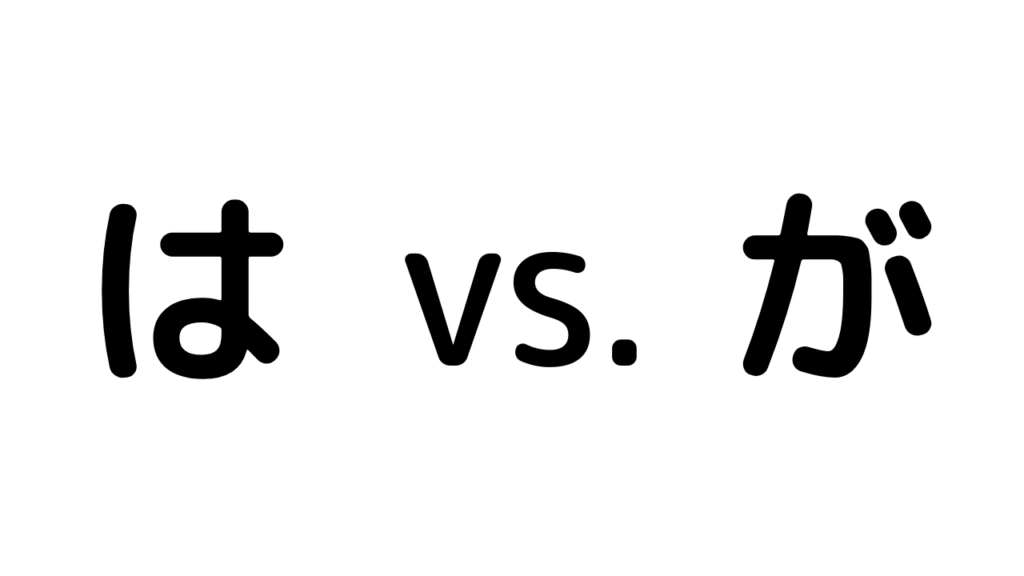
What should you do when you want to ask someone if they speak Japanese? "Anata wa nihongo wo hanashimasuka?" is Japanese for "Do you speak Japanese?" For "Can you speak Japanese?", you can say, "Anata wa nihongo wo hanasemasuka?" Did you notice that there is a one-character difference between "do" and "can"? It is interesting how just one letter can change the meaning of a word. In this article, I will introduce the phrase "Do you speak Japanese? In addition, I will discuss the difference between the particles "HA" and "GA", as well as the difference between "do you?" and "can you?" Read to the end, and you will be able to ask questions in Japanese! Is "Do you speak Japanese?" means, "Do you speak Japanese?" The answer is, "あなたは、日本語を話しますか?" This is how to read it.あなた (anata) は (wa) 日本語(nihongo) を(wo) 話します(hanasimasu) か(ka)? Let's look at the points. (1) Japanese interrogative sentences end with "ka? at the end. (2) In Japanese "You (do) speak Japanese" ・you = あなた(anata)・(do) = は(wa)・speak Japanese 日本語を話します(nihongo wo hanasimasu): a polite version of 話す(hanasu) + Question "ka?" The diferent between ”Anata WA nihongo wo hanasimasu” and “Anata GA nihongo wo hanasimasu” Now lets look at the difference between, "Anata WA nihongo wo hanasimasu" and "Anata GA nihongo wo hanasimasu." The particles "は (WA)" and "が (GA)" are used according to what part of the sentence you want to emphasize. 「は(WA)」 ・The information you want to convey comes at the end. (eg. 新しい先生は山田先生です/ atarashii sensei wa yamada-sensei desu) ・Adjectives (eg. 桜の花はきれいです/ sakura no hana wa kirei desu) ・Noun sentences (eg. 明日は水曜日です/ ashita wa suiyoubi desu) 「が(GA)」 ・The information you want to convey comes at the beginning. (eg. 新しい先生が山田先生です/ atarashii sensei ga yamada-senseidesu) ・Dependent clause (eg. 私が起きたとき、母はいませんでした/ watashi ga okitatoki, haha wa imasendesita) ・Noun-modifying clause (eg. 猫が汚したソファは捨てました/ neko ga yogosita sofa ha sutemasita) "あなたは(WA)日本語を話しますか。" is trying to convey the "speak Japanese" part. On the other hand, "Do you (GA) speak Japanese? emphasizes the fact that it is "you" who are speaking Japanese (It's similar to a question: Are you the person who speak Japanese?). Therefore, "あなたは(WA)、日本語を話しますか?" is more appropriate. The difference from "Can you speak Japanese?" So far, we have summarized how to ask "Do you speak Japanese?" in Japanese. Then what about "Can you speak Japanese? The word that follows the verb in Japanese changes between can and do. The "話します" in "あなたは日本語を話しますか?" is: 話す(hanasu) = 動詞(speak) +ます(masu) = Polite (1)In case of “do” for 話す(hanas"u") Instead of the “i"、 it becomes 話し(hanas"hi")+ます(masu) (2)In case of “can” for 話す(hanas"u") Instead of the "e"、 it becomes 話せ(hanas"e")+ます(masu) If you want to learn Japanese In Japanese, "Do you speak Japanese?" is "Anata was nihongo wo hanasimasuka?" There are many things you can learn just by memorizing one Japanese phrase. In this article, we have explained the basic grammar, but you might not be able to use it right away. Also, Japanese might not use correct grammar. To learn to use them in conversation, it is a good idea to actually use them with Japanese people. However, there are some people who do not have Japanese friends or who find it difficult to go to Japan. That is why Ohanasi Kagawa holds online exchange events between Japanese and English learners. Japanese learners and English learners are paired, and you can switch languages every 15 minutes. This creates an environment where you can teach and learn from each other. This is a fun event for those who want to practice what they have learned. Come and have to see! Ohanasi Kagawa Website >>> That said, you might still not be confident in your Japanese speaking ability. You’re not sure how to study Japanese. For people like that, we are currently offering free Japanese language consultation and free lessons for a limited number of 10 people each month.You don’t know how to study Japanese. If you are interested in taking Japanese lessons to solve what you don’t understand, please feel free to join us.If you are interested, please click the URL or image below. Click here to see more details >>>
Ohanasi Kagawa
Japanese Culture
2023.02.25
Learn About the Different Types of Sushi and Enjoy Sushi Even More!
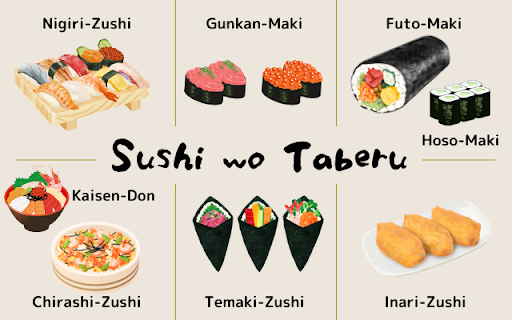
Sushi is always one of the top three things foreigners want to eat when they visit Japan. Eating good sushi in Japan is one of the things people probably look forward to doing. But do you know what real sushi is? Salmon and toro nigiri are not the only types of sushi. There are more sushi ingredients than you know. And there are many different types of sushi. Here are some popular types of sushi that Japanese people also love. What types of sushi are there? Do you eat sushi at a high-end sushi restaurant? Or do you eat sushi at a conveyor belt sushi restaurant? Sushi is an important part of Japanese culture. You can find cheap and tasty sushi in many places around you. You can also easily find sushi at convenience stores and supermarkets. Try the wide variety of sushi available in Japan. にぎりずし Nigiri-zushi Type of sushi with sashimi (sushi ingredients) on top of a bed of vinegared rice. Most people think of nigiri-zushi when they think of sushi. The most common types of sushi are: red fish, white fish, hikarimono (silver-skinned fish), boiled fish, squid, octopus, and tamagoyaki (egg omelet). You can use wasabi to your liking. ぐんかんまき Gunkan-maki Sushi made by placing ingredients like salmon roe, sujiko, or negitoro on a bed of vinegared rice and wrapping it with nori (seaweed). It is called gunkanmaki because it looks like a boat (gunkan). The fish roe is slightly seasoned, so it can be eaten as it is. まきずし Maki-zushi Also called Nori-maki. It is made by spreading sushi rice over a bed of nori and topping it with sushi ingredients. ふとまき Futo-maki Sushi rolled with multiple sushi ingredients, such as sashimi, egg omelets, and cucumber. During Setsubun (festival to celebrate spring), it is customary to eat sushi rolls called ehomaki to bring in "good luck." It is about five centimeters in size and is rolled with a lot of seafood. ほそまき Hosho-maki Sushi roll with a single ingredient. You can use ingredients such as cucumber, natto, negitoro, kanpyo (dried gourd), takuan (pickled radish), and so on. It is recommended when you want to eat only a little. ちらしずし Chirashi-zushi Sushi that is not hand-rolled. Shrimp, octopus, and other seafood, shiitake mushrooms, and a broiled egg are placed on a bed of vinegared rice. This sushi is beautiful. It is customary to eat it on Hinamatsuri (Girls' Day). かいせんどん Kaisen-don Sushi that has not hand-rolled sushi. It is usually served on a bowl of vinegared rice with sashimi, shrimps, salmon roe, and sea urchin on top. It is a gorgeous bowl of rice. てまきずし Temaki-zushi Sushi made by placing sushi rice on a small piece of nori and wrapping it around your favorite sushi ingredients and vegetables. Temaki-zushi parties are often held at home. It is also on the menu at conveyor-belt sushi restaurants. いなりずし Inari-zushi Sushi consists of sweet fried bean curd with sushi rice inside. You can use rice such as simple white rice, go-moku rice, and bean rice. At first glance, it does not look like sushi, but it is popular among children. Sushi available in the region There are sushi specialties in each region of Japan. Why not try them when you visit Japan on vacation? 【Toyama prefecture】Mashu-zushi Sushi rice wrapped in light red sakura salmon and wrapped with young leaves. It is also famous as an ekiben (station bento) at Toyama Station. 【Nara prefecture】Kaki no ha zushi Oshi-zushi that is made by placing thin slices of vinegared fish such as mackerel or salmon on vinegared rice and wrapping it in persimmon leaves. 【Okayama prefecture】Mamakari zushi Sushi made from small sappa fish (clupeoid) from the Seto Inland Sea coast, sprinkled with salt, and marinated in vinegar. Ohanasi Kagawa holds online language exchange events on weekends. Japanese language learners and English language learners are paired together. You then switch between English and Japanese every 15 minutes. This way, both of you can learn a language. Online, you can communicate with Japanese people without having to go to Japan. The rules are designed to ensure that you can participate safely. So, even if you are new to online events, please check them out. This is the perfect event for those who want to spend a little time in Japanese while maintaining their current lifestyle. Ohanasi Kagawa Website >>> That said, you might still not be confident in your Japanese speaking ability. You’re not sure how to study Japanese. For people like that, we are currently offering free Japanese language consultation and free lessons for a limited number of 10 people each month.You don’t know how to study Japanese. If you are interested in taking Japanese lessons to solve what you don’t understand, please feel free to join us.If you are interested, please click the URL or image below. Click here to see more details >>>
Ohanasi Kagawa
No Category
2023.02.25
Many People are Addicted! Highly Recommended Japanese Sweets with Anko
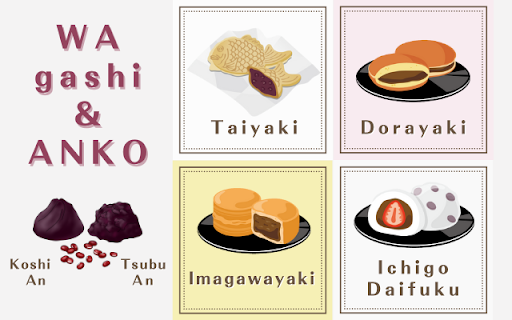
Japanese sweets are a must-try among Japanese foods. In particular, I would like to recommend Japanese sweets using "anko" (red bean paste). Anko is made from sweetened and mashed azuki beans. It is also called "an." It is a popular ingredient in traditional Japanese sweets. Foreigners may feel some resistance to food made from sweetened beans. However, anko and bean foods are not the same thing. Once you try it, you will be surprised at how delicious it is. And you may be addicted to its cute appearance. Today, we will introduce some typical Japanese sweets using anko. こしあん"Koshi-an" and つぶあん"Tsubu-an" are two types of red bean paste There are two main types of red bean paste. One is "koshi-an." Koshi-an is made from cooked azuki beans that have been mashed and then strained. The outer skin of the azuki bean curd is removed so that the texture is very smooth. The other is "tsubu-an." Tsubu-an is made by cooking azuki beans softly, leaving the grains and skin. People either prefer koshi-an or tsubu-an. The colors of red bean paste which are called あかあん "Aka-an" and しろあん "Shiro-an" The color of red bean paste made from azuki beans is described as "aka." Technically, it is not red but rather a brownish-reddish-purple or purplish-reddish-brown color. The general term "aka-an" refers to red bean paste made from red beans such as red kidney beans as well as azuki beans. There is also a type of red bean paste called "shiro-an." "Shiro-an" is made from white beans, such as white kidney beans and white flower beans, cooked sweetly and mashed. Japanese sweets using あんこ "anko" たいやき Taiyaki It is shaped like a fish and filled with tsubuan on the inside. It may seem strange that there is bean paste in a fish, but it is a cute-looking Japanese sweet. There are specialty stores in Asakusa and other sightseeing spots. It is recommended to eat them while walking around. どらやき Dorayaki This Japanese sweet is made with a fluffy pancake-like dough stuffed with tsubu-an. Honey is used in the batter, making it moist and fluffy. Some pancakes contain chestnuts or shiratama (white rice balls like mochi) along with the red bean paste. They are available at convenience stores, supermarkets, and Japanese confectionery stores. いまがわやき Imagawayaki It is a Japanese sweet with a round shape and a filling of tsubuan or shiroan inside. It is sometimes called "oban-yaki" or "kaiten-yaki," depending on the region. In Hyogo Prefecture and the Kansai region, Imagawa-yaki is called "Gozasouro." This is the name of the Imagawa-yaki store that originated in Hyogo. "Gozasoro" is loved by the locals, and is now easily found in the food sections of department stores all over the country. It can be eaten in department stores and tourist areas. だいふく Daifuku It is a Japanese sweet made of mochi dough and wrapped with either koshi-an or tsubu-an. There are many ways to arrange the bean paste and the dough. Mame daifuku is made by boiling large peas or black beans with salt and wrapping them in mochi dough. There are also various types of Daifuku, such as salty salt Daifuku and Kusa Daifuku with yomogi (mugwort). We especially recommend the strawberry daifuku. It contains a single strawberry wrapped in mochi dough and koshian. It can be purchased at convenience stores, supermarkets, department stores, and Japanese confectionery stores. There are many other Japanese sweets using anko. おだんご Odango ようかん Youkan 八つ橋 Yatsuhashi 最中 Monaka あんぱん Anpan あんみつ Anmitsu おしるこ Oshiruko The list is endless when you include famous local confections. That is how inseparable Japanese sweets and anko are. Let's get to know Anko, talk about Japanese sweets, and have fun at Ohanashi Kagawa!
Ohanasi Kagawa
No Category
2023.02.25
Even beginners can use it! What is useful Japanese?
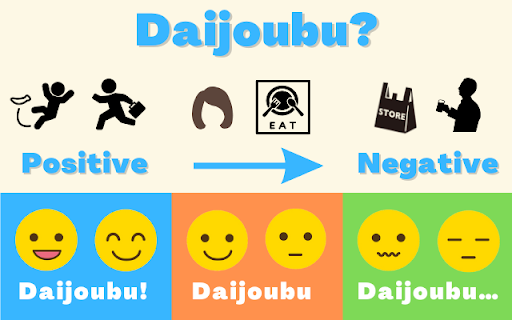
What Japanese do you know? When you are just beginning to learn Japanese, you have to memorize a lot of words. Konnichiwa Itadakimasu Kawaii Arigato These words are also important Japanese words for communication. However, there are more useful words. Words that are one word but can be used in various situations. Here are some words and ways to use them: We recommend these words for beginners who wish to speak Japanese. The word だいじょうぶ "Daijoubu". The word "daijoubu" can be used conveniently with various meanings. In fact, "daijoubu" is a strange word that has both positive and negative meanings. The pronunciation of "daijoubu" is not difficult even for foreigners, so it can be very useful once you learn the situations in which it is used. If you know how to use this word, even beginners in Japanese should be able to speak like native speakers. だいじょうぶ "Daijoubu" with a positive meaning When you fall or get injured 「大丈夫?」 「大丈夫」 「Daijoubu?」 「Daijoubu」 If nothing happened or if the injury was not serious. When you catch a cold and was absent from school. 「たいちょうは大丈夫?」 「大丈夫」 「Are you feeling daijoubu?」 「Daijoubu」 If you are not that sick and recovering. When you are busy at work. 「たいへんそうだけど大丈夫?」 「大丈夫」 「You look busy. Daijoubu?」 「Daijoubu」 If you can manage on your own. When confirming an appointment. 「あしたのよていは大丈夫?」 「大丈夫」 「Are you daijoubu for tomorrow’s appointment?」 「Daijoubu」 If you are going to be on schedule. When you are asked to do something 「これ、きょうじゅうにできる?」 「大丈夫」 「Can you finish this by tomorrow?」 「Daijoubu」 If you know you can do it or are confident about it. Positive "daijoubu" is a common pharse in everyday life. だいじょうぶ "Daijoubu" that has both a positive and negative meaning When asked for opinions on the food. 「Is it good?」 「Daijoubu」 When asked about a new hairstyle or outfit. 「How’s my haircut?」 「Daijoubu」 One must be careful with the answer "Daijoubu" in this situation. It can mean "good" in a positive way, but it can also mean "not good" at the same time. だいじょうぶ "Daijoubu" with a negative meaning. When asked if you want a plastic bag at a convenience store. 「ふくろはいりますか?」 「大丈夫です」 「Do you need a plastic bag?」 「Daijoubu desu」 When you need one. When you want to decline an invitation. 「きょう、のみにいこうか?」 「大丈夫です」 「Do you want to go out for a drink?」 「Daijoubu desu」 When you don’t want to go. Although the correct response would be "irimasen" or "ikimasen," it is commonly used by Japanese who cannot say "no" directly and prefer to decline softly. "Better get used to it than learn it." As the Japanese proverb says, practice makes perfect! Let's talk with people using "daijoubu" at Ohanashi Kagawa!
Ohanasi Kagawa
No Category
2023.02.25
Useful Japanese for Beginners【すみませんSumimasen】
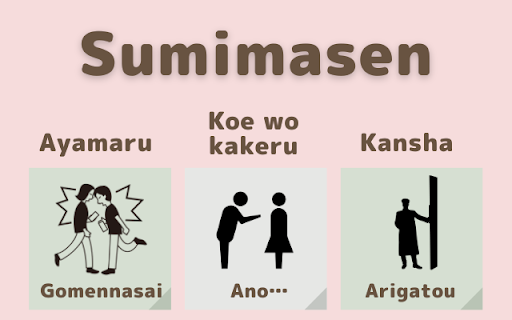
In a previous column, I introduced "Daijyoubu" as a useful Japanese word that can be used by beginners. Today, I would like to recommend "Sumimasen" as the second useful Japanese word! "Suminasen" has several meanings depending on how you use it. When you apologize When you call out to someone When you show your appreciation At first, it may seem complicated, but if you know the situations in which it is used, it is not difficult to use it in conversation. "Sumimasen" is a common word used in everyday life. Once you understand how to use it, even beginners in Japanese will be able to communicate effectively. Here are some easy explanations of how to use "すみません sumimasen" in many different situations. "すみません Sumimasen" used when apologizing The word "sumimasen" is used to apologize. This is the same meaning as "gomennasai." It is a slightly more polite way of apologizing to someone you don't know or to someone you are not very close to. When you bump into someone: 「すみません」 " Sumimasen" When you are late for an appointment: 「すみません。おそくなりました」 "Sumimasen. I'm late." When you break something: 「すみません。コップをわってしまいました」 "Sumimasen. I broke a glass." Notes. When apologizing after a fight with a friend, you do not use "すみません sumimasen." In this case, it is "ごめんなさい Gomennasai." "すみません Sumimasan" used when calling out to someone. We use "sumimasen" as a word to call out to people. When there are people around the train door and you can't get through: 「すみません。おります」 "Sumimasen. I’m getting off." When you want to call an waiter at a restraunt: 「すみません。ちゅうもんをおねがいします」 "Sumimasen. Please take an order." When you want to ask a question: 「すみません。しぶやえきはどこですか」 "Sumimasan. Where is Shibuya Station." The word "sumimasen" is very common in everyday life. In many cases, it is used to address strangers rather than close friends. "すみません Sumimasen" used to express a gratitude The word "sumimasen" is also used to express your gratitude. It has the same meaning as "thank you," but is often used when someone is kind to you. When someone opened a door for you. When someone offered you a seat on the train When someone waited for you to get on the elevator. The word "sumimasen" to express your thanks can also be replaced by the polite "Arigato gozaimasu." Once you understand the three meanings of "sumimasen" and learn how to use it, you will enjoy Japanese conversation even more. Trying using "suminasen" and speak up at Ohanashi Kagawa!
Ohanasi Kagawa


Popular Articles
- Learn About the Different Types of Sushi and Enjoy Sushi Even More!
Sushi is always one of the top three things foreigners want to eat when the...
- What languages are spoken in Japan? If you want to study Japanese! Types, official language, and second language.
If you are interested in Japan, the first thing you will probably wonder ab...
- Ohanasi Kagawa Event Participation Instructions
In this page, we will tell you how to participate in the Ohanasi Kagawa lan...