![Protected: [Limited Sharing] I’ll tell you Ohanasi Kagawa’s secrets stealthily.](https://ohanasikagawa.com/wp-content/uploads/2024/05/23065680_m-1-1024x683.jpg)
Ohanasi News
No Category
2024.05.18
Protected: [Limited Sharing] I’ll tell you Ohanasi Kagawa’s secrets stealthily.
I would like to tell you Ohanasi Kagawa's secrets only to those who have answered the questionnaire. Thank you very much for taking the time to answer Ohanasi Kagawa's limited-time survey. We will continue to improve Ohanasi Kagawa based on your feedback. And as a benefit to those of you who have filled out the questionnaire, I would like to quietly share with you some of Ohanasi Kagawa's secrets. Aki, the founder of Ohanasi Kagawa, writes this blog, and sometimes when I attend events as a participant, people ask me, "How did you create Ohanasi Kagawa? Why did you decide to start Ohanasi Kagawa? I am often asked many questions about Ohanasi Kagawa. So this time, I would like to share the story behind Ohanasi Kagawa, from the creation of Ohanasi Kagawa to what you might think, "Oh, really? I hope you will enjoy this article to the very end. Please do not tell this story to anyone else. Q1: How did Ohanasi Kagawa come to be? First of all, I would like to answer the most frequently asked question, "How did Ohanasi Kagawa come to be? Ohanasi Kagawa is now held online, but it was originally held locally. It started in September 2018 in Kagawa, Japan, where I, Aki, am from. To begin with, what made me decide to create it, I myself quit my job at the age of 23 at the time and was studying English while saving money to enroll in college in the United States. I won't go into details, but while I was learning English, I wanted to speak more English with people from other countries. So I looked for a place in my hometown, Kagawa Prefecture, where I could speak English with people from overseas. However, no matter how much I looked on the Internet, went to international exchange centers, or walked around town, I couldn't find a place where I could speak English with people from overseas. In cities like Tokyo, Osaka, and Fukuoka, there are many opportunities to interact with people from overseas, but in a rural area like Kagawa Prefecture, it is difficult to find a place where you can get to know people from overseas and speak English with them. I was at a loss as to what to do. I gave up on the idea that unless I studied abroad, I would never be able to have an environment where I could use English. I was already feeling frustrated about that. One day, I came to know that an acquaintance of mine was frustrated because, like me, she wanted to speak English with people from other countries but had no such opportunities. There are others who are struggling with the same problem as I am. No matter how hard I look for it, I cannot find the environment I want. If it doesn't exist, let's create it!" With this decision, I launched Ohanasi Kagawa, which brings together people from overseas living in Kagawa Prefecture and enables them to interact with Japanese people in the form of a language exchange. Q2: How did Ohanasi Kagawa spread online? Actually, Ohanasi Kagawa will be held for the 173rd time on May 18, 2024. Ohanasi Kagawa events have been attended by over 3,000 participants from more than 50 countries, but aren't you wondering how Ohanasi Kagawa has spread so widely online? Actually, Ohanasi Kagawa, which was launched in Kagawa Prefecture, was closed once in 2019 because I was enrolling in a college in the United States. However, it was during my study abroad in the U.S. that the COVID-19 pandemic occurred. I, Aki, was living in an apartment in the US at the time, and suddenly all my classes went online because of the COVID-19, and international students were almost kicked out of the US, which was quite hard to deal with. I was forced to stay at home and do my assignments. Aki was into meditation at the time, and while meditating, an idea came to me! The idea! I thought, "Why don't I hold the Ohanasi Kagawa event online? So I held Ohanasi Kagawa online for the first time with only 5 participants, including myself haha. Still, it was new and fun, so I posted the event on the event board to try to get more people to attend. The next day, I was surprised to see that more than 30 people had signed up to participate! I thought, "Maybe there is a huge demand for this? I asked my housemate who was living in the same apartment at the time about it, and the online Ohanasi Kagawa event began to expand. If it weren't for COVID-19, I would have never thought of holding an online event, but I was able to have hope that because it was online, we could connect Japanese people with people around the world who were learning Japanese. Q3 : Ohanasi Kagawa holds its events for free, but how does it cover its running costs? Ohanasi Kagawa has always organized its events for free. We will probably continue to hold events for free in the future. (Of course, we may charge for some optional things, though…) It might sound like fine-sounding talk, but the reason is that I hope to create a society where young people who want to learn English and people like myself in the past who wanted to interact with people from other countries but didn't have the money can interact with people from other countries easily and safely. Of course, Life is not easy. Ohanasi Kagawa's expenses include personnel costs, Remo platform, website, advertising, and so on. At first, we had to make do with our own pocket money, and support from participants, and sponsors, but there was a limit to what we could do, and many times we were driven to the point where we could not continue Ohanasi Kagawa events due to lack of money. It was also getting hard to spend days just asking for support money from the participants. With a desire to get out of that situation, we decided to start a crowdfunding campaign, reached our goal of 2 million yen, and used the funds to start our own business. Now we run an online Japanese language school and an English language school, and we are able to run Ohanasi Kagawa with the profits generated from these schools. I am keenly aware that money is necessary to do what I want to do, and we are working hard to create a good service. Q4 : The idea of Ohanasi Kagawa was actually born from ・・・ Ohanasi Kagawa events are mainly one-on-one, with people taking turns speaking in Japanese and English to exchange languages, right? The service was actually modeled after a particular service. I haven't said much about it, so this is a bit of a backstory, but the concept of "Machicon" Local matchmaking meetup was used as a model. For those of you who have never been to a "Machicon", let me briefly explain. Men and women who are looking for love and marriage gather at a single venue or restaurant, and with their profile cards, they have a short one-on-one conversation. Then, when they have talked with everyone, they have free time to talk with the person they are looking for. Yes, you may realize. This is just like Ohanasi Kagawa, isn't it? When I was in my early twenties, I was into "Machicon", and I loved it. I have tried not to say too much about it because people are often surprised or laugh when I say this, but I believe that new ideas are born when existing things are combined with existing things like this. Unfortunately, Aki was once scolded by his girlfriend when she found out that he went to a "Machicon" haha. Did you feel a little bit closer to me? (^-^;) Q5: Why "Ohanasi" in Ohanasi Kagawa is " si" and not "Ohanashi"? I get asked this question a lot. Why Ohanasi and not Ohanashi? Is it just a mistake or is it a design choice? Of course, I know the alphabet, and I know that "shi" is correct. But when I first started thinking about whether to use Ohanasi or Ohanashi, I thought to myself, "Isn't shi kind of bad looking? I also thought that the Apple logo of Steve Jobs, whom I admire and respect, is not a perfect apple, but has a hole in it, right? It seems that people have a habit of looking at imperfect things rather than perfect things. I'll leave it up to you to decide whether this is by design or by accident, but I really feel satisfied with myself that I'm actually getting people's questions, and that I'm getting their attention haha. I want Ohanasi Kagawa to be a place where anyone can feel free to make mistakes. Don't you think that the name of Ohanasi Kagawa is a good representation of that desire? Q6: What can you see in the Ohanasi Kagawa logo? You must be a big fan of Ohanasi Kagawa if you have taken notice of the Ohanasi Kagawa logo! I like the Ohanasi Kagawa logo a lot myself, but first of all, can you tell which temple or shrine you see? The answer is Konpira-san, Konpira Shrine, which is the representative shrine of Kagawa Prefecture! It is a shrine with a very long staircase of 1,368 steps. There are many stores along the stairs, and it is a fun and festive place to visit when you are in Kagawa Prefecture. And the moon-like thing on top of the Kompira-san looks like the moon or a speech mark. You can clearly see the image of a place to talk. The logo also includes cherry blossoms, which represent Japan well. It is also green, the main color of Ohanasi Kagawa, and isn't it cute? If you want, we will make original T-shirts again! haha Q7 : What future vision does Ohanasi Kagawa have? I would like to talk about the future that Ohanasi Kagawa envisions. Ohanasi Kagawa's final goal is to become a platform where people can practice the language they are learning comfortably and easily whenever they want to practice English or Japanese. It will also be a place where Japanese people and people around the world who love Japan can easily and safely connect and support each other. I am not going to go into specifics, so this is a bit abstract. However, I feel that there are many people in the world who are studying Japanese, who love Japan, and who want to build relationships with Japanese people, and it is a waste that there is no place where these people and Japanese people can easily and safely connect with each other. To use an example, Hikoboshi, the Herdsman, and Orihime, the Weaver, are in search of each other, but they are not connected because there is no bridge for them to come closer to each other. Ohanasi Kagawa wants to be a bridge that brings people in Japan and around the world closer together. We believe that this will make Japan and the world a better place. We hope that you will think that we are working to make such a society a reality every day. Summary What did you think? We hope that you have learned some unexpected secrets about Ohanasi Kagawa and have come to love Ohanasi Kagawa even more. Ohanasi Kagawa will continue to improve its services to better serve you, so please let us know if there is anything that concerns you! Thank you for your continued support.

Ohanasi Kagawa
No Category
2023.02.25
Many People are Addicted! Highly Recommended Japanese Sweets with Anko
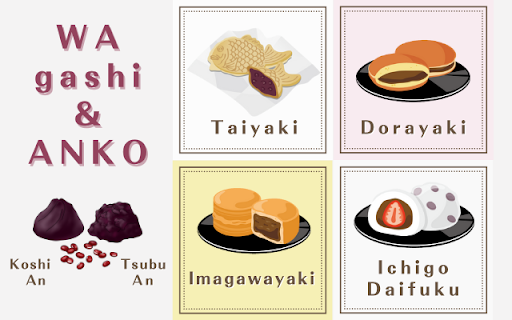
Japanese sweets are a must-try among Japanese foods. In particular, I would like to recommend Japanese sweets using "anko" (red bean paste). Anko is made from sweetened and mashed azuki beans. It is also called "an." It is a popular ingredient in traditional Japanese sweets. Foreigners may feel some resistance to food made from sweetened beans. However, anko and bean foods are not the same thing. Once you try it, you will be surprised at how delicious it is. And you may be addicted to its cute appearance. Today, we will introduce some typical Japanese sweets using anko. こしあん"Koshi-an" and つぶあん"Tsubu-an" are two types of red bean paste There are two main types of red bean paste. One is "koshi-an." Koshi-an is made from cooked azuki beans that have been mashed and then strained. The outer skin of the azuki bean curd is removed so that the texture is very smooth. The other is "tsubu-an." Tsubu-an is made by cooking azuki beans softly, leaving the grains and skin. People either prefer koshi-an or tsubu-an. The colors of red bean paste which are called あかあん "Aka-an" and しろあん "Shiro-an" The color of red bean paste made from azuki beans is described as "aka." Technically, it is not red but rather a brownish-reddish-purple or purplish-reddish-brown color. The general term "aka-an" refers to red bean paste made from red beans such as red kidney beans as well as azuki beans. There is also a type of red bean paste called "shiro-an." "Shiro-an" is made from white beans, such as white kidney beans and white flower beans, cooked sweetly and mashed. Japanese sweets using あんこ "anko" たいやき Taiyaki It is shaped like a fish and filled with tsubuan on the inside. It may seem strange that there is bean paste in a fish, but it is a cute-looking Japanese sweet. There are specialty stores in Asakusa and other sightseeing spots. It is recommended to eat them while walking around. どらやき Dorayaki This Japanese sweet is made with a fluffy pancake-like dough stuffed with tsubu-an. Honey is used in the batter, making it moist and fluffy. Some pancakes contain chestnuts or shiratama (white rice balls like mochi) along with the red bean paste. They are available at convenience stores, supermarkets, and Japanese confectionery stores. いまがわやき Imagawayaki It is a Japanese sweet with a round shape and a filling of tsubuan or shiroan inside. It is sometimes called "oban-yaki" or "kaiten-yaki," depending on the region. In Hyogo Prefecture and the Kansai region, Imagawa-yaki is called "Gozasouro." This is the name of the Imagawa-yaki store that originated in Hyogo. "Gozasoro" is loved by the locals, and is now easily found in the food sections of department stores all over the country. It can be eaten in department stores and tourist areas. だいふく Daifuku It is a Japanese sweet made of mochi dough and wrapped with either koshi-an or tsubu-an. There are many ways to arrange the bean paste and the dough. Mame daifuku is made by boiling large peas or black beans with salt and wrapping them in mochi dough. There are also various types of Daifuku, such as salty salt Daifuku and Kusa Daifuku with yomogi (mugwort). We especially recommend the strawberry daifuku. It contains a single strawberry wrapped in mochi dough and koshian. It can be purchased at convenience stores, supermarkets, department stores, and Japanese confectionery stores. There are many other Japanese sweets using anko. おだんご Odango ようかん Youkan 八つ橋 Yatsuhashi 最中 Monaka あんぱん Anpan あんみつ Anmitsu おしるこ Oshiruko The list is endless when you include famous local confections. That is how inseparable Japanese sweets and anko are. Let's get to know Anko, talk about Japanese sweets, and have fun at Ohanashi Kagawa!
Ohanasi Kagawa
No Category
2023.02.25
Even beginners can use it! What is useful Japanese?
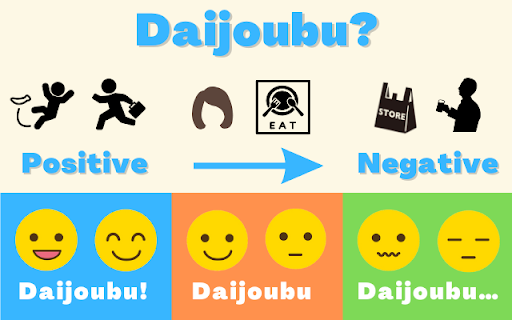
What Japanese do you know? When you are just beginning to learn Japanese, you have to memorize a lot of words. Konnichiwa Itadakimasu Kawaii Arigato These words are also important Japanese words for communication. However, there are more useful words. Words that are one word but can be used in various situations. Here are some words and ways to use them: We recommend these words for beginners who wish to speak Japanese. The word だいじょうぶ "Daijoubu". The word "daijoubu" can be used conveniently with various meanings. In fact, "daijoubu" is a strange word that has both positive and negative meanings. The pronunciation of "daijoubu" is not difficult even for foreigners, so it can be very useful once you learn the situations in which it is used. If you know how to use this word, even beginners in Japanese should be able to speak like native speakers. だいじょうぶ "Daijoubu" with a positive meaning When you fall or get injured 「大丈夫?」 「大丈夫」 「Daijoubu?」 「Daijoubu」 If nothing happened or if the injury was not serious. When you catch a cold and was absent from school. 「たいちょうは大丈夫?」 「大丈夫」 「Are you feeling daijoubu?」 「Daijoubu」 If you are not that sick and recovering. When you are busy at work. 「たいへんそうだけど大丈夫?」 「大丈夫」 「You look busy. Daijoubu?」 「Daijoubu」 If you can manage on your own. When confirming an appointment. 「あしたのよていは大丈夫?」 「大丈夫」 「Are you daijoubu for tomorrow’s appointment?」 「Daijoubu」 If you are going to be on schedule. When you are asked to do something 「これ、きょうじゅうにできる?」 「大丈夫」 「Can you finish this by tomorrow?」 「Daijoubu」 If you know you can do it or are confident about it. Positive "daijoubu" is a common pharse in everyday life. だいじょうぶ "Daijoubu" that has both a positive and negative meaning When asked for opinions on the food. 「Is it good?」 「Daijoubu」 When asked about a new hairstyle or outfit. 「How’s my haircut?」 「Daijoubu」 One must be careful with the answer "Daijoubu" in this situation. It can mean "good" in a positive way, but it can also mean "not good" at the same time. だいじょうぶ "Daijoubu" with a negative meaning. When asked if you want a plastic bag at a convenience store. 「ふくろはいりますか?」 「大丈夫です」 「Do you need a plastic bag?」 「Daijoubu desu」 When you need one. When you want to decline an invitation. 「きょう、のみにいこうか?」 「大丈夫です」 「Do you want to go out for a drink?」 「Daijoubu desu」 When you don’t want to go. Although the correct response would be "irimasen" or "ikimasen," it is commonly used by Japanese who cannot say "no" directly and prefer to decline softly. "Better get used to it than learn it." As the Japanese proverb says, practice makes perfect! Let's talk with people using "daijoubu" at Ohanashi Kagawa!
Ohanasi Kagawa
No Category
2023.02.25
Useful Japanese for Beginners【すみませんSumimasen】
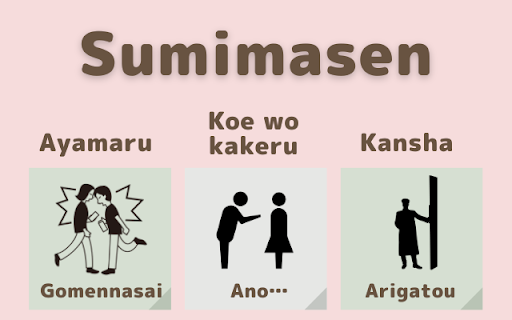
In a previous column, I introduced "Daijyoubu" as a useful Japanese word that can be used by beginners. Today, I would like to recommend "Sumimasen" as the second useful Japanese word! "Suminasen" has several meanings depending on how you use it. When you apologize When you call out to someone When you show your appreciation At first, it may seem complicated, but if you know the situations in which it is used, it is not difficult to use it in conversation. "Sumimasen" is a common word used in everyday life. Once you understand how to use it, even beginners in Japanese will be able to communicate effectively. Here are some easy explanations of how to use "すみません sumimasen" in many different situations. "すみません Sumimasen" used when apologizing The word "sumimasen" is used to apologize. This is the same meaning as "gomennasai." It is a slightly more polite way of apologizing to someone you don't know or to someone you are not very close to. When you bump into someone: 「すみません」 " Sumimasen" When you are late for an appointment: 「すみません。おそくなりました」 "Sumimasen. I'm late." When you break something: 「すみません。コップをわってしまいました」 "Sumimasen. I broke a glass." Notes. When apologizing after a fight with a friend, you do not use "すみません sumimasen." In this case, it is "ごめんなさい Gomennasai." "すみません Sumimasan" used when calling out to someone. We use "sumimasen" as a word to call out to people. When there are people around the train door and you can't get through: 「すみません。おります」 "Sumimasen. I’m getting off." When you want to call an waiter at a restraunt: 「すみません。ちゅうもんをおねがいします」 "Sumimasen. Please take an order." When you want to ask a question: 「すみません。しぶやえきはどこですか」 "Sumimasan. Where is Shibuya Station." The word "sumimasen" is very common in everyday life. In many cases, it is used to address strangers rather than close friends. "すみません Sumimasen" used to express a gratitude The word "sumimasen" is also used to express your gratitude. It has the same meaning as "thank you," but is often used when someone is kind to you. When someone opened a door for you. When someone offered you a seat on the train When someone waited for you to get on the elevator. The word "sumimasen" to express your thanks can also be replaced by the polite "Arigato gozaimasu." Once you understand the three meanings of "sumimasen" and learn how to use it, you will enjoy Japanese conversation even more. Trying using "suminasen" and speak up at Ohanashi Kagawa!
Ohanasi Kagawa
No Category
2023.02.25
Telling the Texture! Cute Japanese Expressions
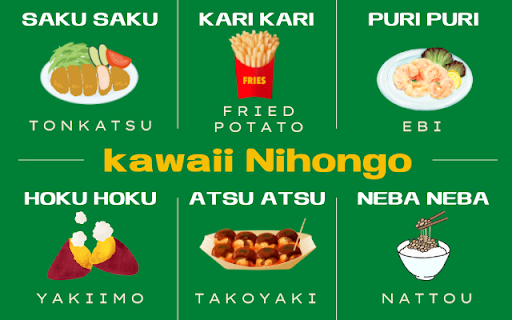
What cute Japanese expressions do you know? Japanese adverbs include words that describe the state of things in detail. Words that are formed by combining words into a single word are called "Jogo (畳語)". For example: きらきら Kirakira さらさら Sara sara ほのぼの Hono bono すくすく Suku suku The word " Jogo" may sound difficult, but don't worry. Most Japanese people do not even know the word "Jogo". It is a simple word, but it is not the language of young children, and is commonly spoken and heard in daily life. It is casually used in various situations. In this issue, we will introduce some cute Japanese words related to the "texture of food." What is ふわふわ fuwa fuwa? What comes to mind when you hear the word "fuwa fuwa"? Most Japanese people think of bread. You see it in commercials and at bakeries as "fuwa fuwa bread" or "fuwa fuwa texture." Japanese people love soft and fluffy bread. Japanese words for texture like this remind us of what kind of food we are eating. And it is important to understand what kind of condition the food is in. Cute words to describe texture 「さくさく Saku saku」 Fried pork cutlets, fried shrimp, croquettes, tempura, and curry buns. Used when fried food is crispy. 「かりかり Kari kari」 French fries, well-cooked bacon, and small hard pickled plums Use for slightly hard and chewy foods. 「ぷりぷり Puri puri」 Shrimp, squid, and octopus. Used for firm and chewy foods. 「ほくほく Hoku hoku」 Sweet potatoes, pumpkins, and chestnuts. Often used for autumn foods. 「あつあつ Atsu atsu」 Ramen, soup, sukiyaki, and takoyaki. Used for foods cooked warm. 「ねばねば Neba neba」 Natto, okra, yams, and nameko mushrooms. Used for sticky foods. Is it different from onomatopoeia? Onomatopoeia is a language that uses verbal onomatopoeia, mimetic words, and gibberish to describe the state of things, movements, and animal noises. Wan wan, doki doki, za- za,Sube sube, and so on. Onomatopoeia is not only formed by combining words into a single word: はくしょん Hakushon がっかり Gakkari うんざり Unzari ガシャン Gashan パチン Pachin おぎゃー Ogyaa There are many different ways of expression. "Jogo" is a part of onomatopoeia. There are many more cute Japanese words to describe food. Let's check out what words are used for ingredients, cooking methods, and food conditions! You are sure to find a cute expression. How many words can you say to describe the texture? Let's talk about food at Ohanashi Kagawa!
Ohanasi Kagawa
No Category
2023.02.25
Useful to Know! The Japanese Word for Pain
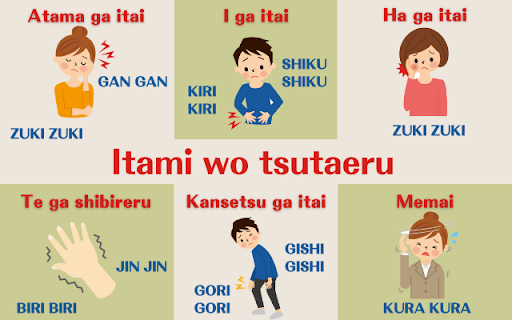
It is painful when you feel pain in your body. You may feel pain when you are sick, injured, or have stomach pain for an uncertain reason... There are many possible situations. In Japanese, we don't use difficult words to describe pain. It can be conveyed with onomatopoeia, a word made up of a single word combined with other words. For example, when you go to the hospital with a headache, the doctor may ask you: "What kind of pain is it?" How would you answer it? Throbbing (zuki zuki) Pounding (gan gan) We use these words when we have a headache. Today, I will introduce some useful Japanese words that you should know. This way, you could reduce stress of not being able to communicate well even though you are not feeling well. What kind of pain do you feel? When your tooth hurt ずきずき Zuki zuki When your finger is stuck in a door じんじん Jin jin When one has a stomach ache きりきり Kiri kiri しくしく Shiku shiku When you have a sore throat いがいが Iga iga When the limbs go numb じんじん Jin jin びりびり Biri biri When the skin is sunburnt ひりひり Hiri hiri When you have stomach ache ちくちく chiku chiku しくしく Shiku shiku When your bones or joints hurt ぎしぎし Gishi gishi ごりごり Gori gori When you have a burns and peeling skin ぴりぴり Piri piri ひりひり Hiri hiri Words to use when you're not feeling well Dizziness くらくら Kura kura Nausea むかむか Muka muka When the hands and feet are swollen ぱんぱん Pan pan When your heartbeat quickens どきどき Doki doki Will the hosipital understand? 「胃がきりきりと痛む」 "E ga kirikiri itamu (I have a splitting stomach ache)." Most Japanese can imagine what kind of pain it is. The expression "kiri kiri" is accepted as common knowledge. Of course, it is also understood in hospitals. When a doctor asks patients, 「どんな痛みですか」"What kind of pain do you have?" It is better to use onomatopoeia such as "zuki zuki," "gan gan," or "shiku shiku" to convey the pain more accurately than explain it in other ways. Things to watch out for It can be complicated until you get used to describing pain. When you feel a headache, you will realize that it is a throbbing feeling. It is hard to experience each pain separately. However, you must be careful not to use the wrong word for pain. Do not say, "Nodo ga gangan itai (my throat is pounding)," or "Atama ga shikushiku itai (I have a griping pain in my head)." Let's first try to apply onomatopoeia to the pain you experience. It is very useful to know what kind of pain you are experiencing by sensing the location of the pain and the symptoms. Let's have fun at Ohanashi Kagawa and learn about what expressions of pain we can use!
Ohanasi Kagawa
No Category
2023.02.25
Is Japanese Bread Special? Three Breads You Must Try
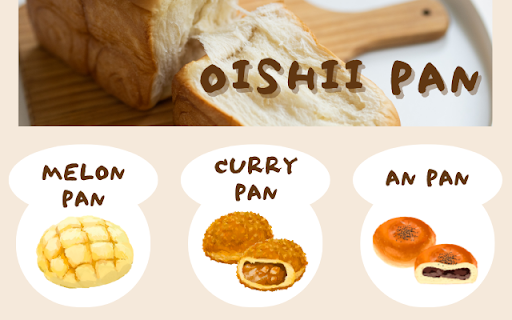
For those interested in Japanese food, I would like to recommend Japanese bread. Many of you might be familiar with Japanese bread. It has appeared in recent anime and manga, along with ramen and onigiri (rice balls). What makes Japanese bread so special is its softness. The fluffy texture of the bread will certainly surprise foreigners who are used to eating hard bread. You will also be surprised at the many varieties of bread available. There are many different types of breads to choose from, ranging from sweet dessert breads to side dish breads with ingredients on top. We recommend freshly baked bread from a bakery, but you can easily find good bread at convenience stores as well. Here are some breads I would like to recommend. When you visit Japan, be sure to try some of these breads. Cute looking メロンパン“Melon pan” Do you know why the melon pan got its name? There are several theories, but one is that it resembles a muskmelon because of the lattice pattern in its appearance. There is no melon in the bread. Some melon pan has a slight aroma of melon. The main feature of the melon pan is the use of cookie dough on top of the bread. At first bite, you will be surprised by the texture of the crispy cookie. Then, you will be impressed by the softness of the bread inside. Recently, there have been melon pans, like the one with cream. However, we recommend you try the simple melon pan. In Asakusa, Tokyo, there is a store that specializes in melon bread. Mysterious food? カレーパン "Curry pan" Curry pan is bread with curry inside. Furthermore, this bread is not baked in an oven but fried in oil. That is why the surface of the bread is crispy. The soft bread is filled with spicy curry, and it can be eaten as a snack or a lunch. There are different kinds of curry ingredients, depending on the bakery. Beef Curry Keema Curry Curry with lots of vegetables If you come across freshly fried curry bread at a bakery, it is worth a try! The classic flavor! あんぱん"An pan" Azuki beans are an essential part of wagashi (Japanese traditional sweets). There are two types of an: tsubu-an and koshi-an. Tsubu-an is made with the azuki bean skin left on, while koshi-an is made by removing the azuki bean skin and rubbing the azuki bean paste into a smooth paste. A pan is available in both koshi-an and tsubu-an. The soft buns are filled with a sweet bean paste that is not too sweet. Anpan is a perfect introduction to Japanese sweets. Why not give it a try? Let's talk about Japanese bread at Ohanashi Kagawa!
Ohanasi Kagawa
No Category
2023.02.25
Enriching Japanese Expressions! Idioms using colors
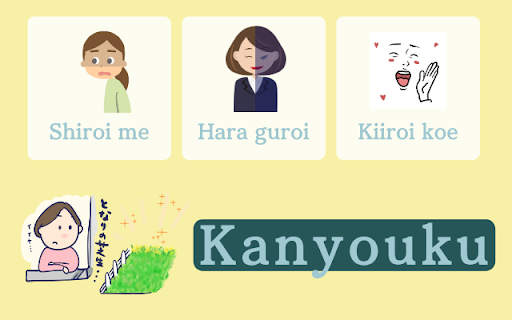
"Japanese is beautiful." "But it is difficult." When you are studying Japanese, you may face such challenges. But you don't have to worry about it. You can improve your language skills by learning Japanese with a curious mind. There are adjectives and adverbs in Japanese that express feelings or convey a state of feeling. You can use onomatopoeia to convey your feelings more clearly. Idioms may also be used to express yourself. Idioms can be difficult to master without thinking in their native language. But if you find the unique phrases interesting, you will be able to learn them. If you understand the idioms used in daily life, you will be able to express yourself more effectively in Japanese. Today, we will introduce some useful idioms using colors. What are “かんようく” idioms? Idioms are expressions that many Japanese are familiar with in their daily lives. Japanese idioms have been used for a long time. An idiom is a unique Japanese phrase made up of two or more words. It expresses a special meaning different from the original meaning of the word. A similar word is "proverb," but an idiom does not contain a lesson or saying and is a short expression. Idioms are used as metaphors for things. There are many unique phrases in Japanese, such as idioms using the body and idioms using animals. "かんようく"Idioms using colors ”Me no iro wo kaeru (目の色を変える)” To change one's eyes in response to anger, surprise, or other changes in emotion Example: "Sukina mono wo miruto meno iro ga kawaru." “Iromegane de miru (色眼鏡で見る)” To view people with preconceptions or prejudice. To have a biased view of things. Example: ”Shotaimen no hito wo iromegane de minaiyouni shiyou.” “Makkana uso (真っ赤な嘘)” An obvious lie. An absolute lie. An unmistakable lie. Example: ”Sorewa jijitsudehanai. Makkana usoda.” “Aka no tanin (赤の他人)” A complete stranger. An unrelated person. A person who has no connection to you. Example: “Anohito towa mattaku kankeiganai. Aka no taninda.” “Shiroi me de mirareru (白い目で見られる)” To be looked at coldly. To be looked at with suspicion. Example: “Densha no nakade oogoe de hanashitara, mawarikara shiroi me de mirareta.” “Hakushi ni modosu” (白紙に戻す)” To return to the original condition. To put things back the way they were. Example: “Jyoukenga awanai koto de kono torihiki wa hakushi ni modoshimasu.” “Me wo shirokuro saseru (目を白黒させる)” To be very surprised. To get surprised and flustered. Example: “Takarakuji ga attate me wo shirokuro saseta.” “Haraguroi (腹黒い)” People who plan things in their minds that are not good. People who are mean. People who plan to do bad things. Example: “Ano hito wa haraguroi kara kage de nani wo itteruka wakaranai.” “Kiiroi koe (黄色い声)” The high-pitched cheers of women and children. It's also called "Kiroi seien." Example: “Aidoru no consert kaijyou wa kiiroi koe de ippaida.” “Tonarino shiba wa aoi (隣りの芝生は青い)” The feeling of seeing other people's things better than your own. The feeling of envying others. Example: “Kochi no cake yori socchi no cake no hou ga oishisou ni mieruno wa, tonarino shiba ga aoku mirerudake.” This idiom is based on an English phrase (The grass is always greener on the other side. ). Let's have a fun conversation using idioms at Ohanashi Kagawa!
Ohanasi Kagawa
No Category
2023.02.25
Are Japanese good at apologizing? 3 Words for Apologizing in Japanese
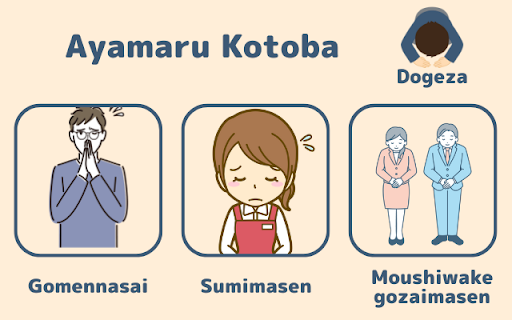
Do you know how many "words of apology" there are in Japanese? The words you use depend on the situation: words for family and friends, words for people you are not close to, and words used in business situations. Compared to foreigners, Japanese people tend to apologize immediately. This is because many Japanese people think that when they bump into someone on the street, for example, it is not the other person's fault. Of course, there are people who blame the other person and get angry. In most cases, it is the Japanese who immediately say the words 「ごめんなさい」 "Gomennasai" or 「すみません」"Sumimasen." In Japan, it is not considered a loss if you apologize first. Being able to apologize properly is also a form of politeness in Japan. In this article, we will explain the types of words to use to apologize in Japanese and how to use them easily. Words of apology 「ごめんなさい」"Gomennasai" 「ごめんなさい」“Gomennasai” 「ごめんね」”Gomenne” 「ごめん」”Gomen” These are used to apologize to family members, friends, and those close to you. They are commonly used in everyday life. Words of apology 「すみません」 "Sumimasen” 「すみません」"Sumimasen" is used when you cause trouble for someone you don't know or don't know very well. It is a slightly more polite apology. For example: ・When you bump into someone on the street ・When you step on someone's foot on the train Words of apology 「もうしわけございません」"Moushiwake gozaimasen” 「もうしわけございません」"Moushiwake gozaimasen" is an apologetic phrase used in business situations. It is used in situations where you are apologizing politely. For example: When the cash register at a store is crowded, 「おまたせして、もうしわけございません」 "Omatasesite moushiwake gozaimasenn." When your order is taking a long time to arrive at a restaurant, 「もうしわけございません。もうしょうしょうお待ちください」 "Moushiwake gozaimasen. Mou shoushou omachikudasai." How to use the right words to apologize Let me explains how to use different words to apologize when you are late for an appointment. To a friend, 「ごめんね」 "Gomenne." At a hair salon 「すみません」 "Sumimasen." To a clients at work 「もうしわけございません」 "Moushiwake gozaimasen." Movement when apologizing There is also a gesture of apology. When used in combination with words of apology, it is more effective in expressing the sense of apology. 「ごめんなさい」 "Gomennasai" Clasping hands 「すみません」 "Suminasen" Bow your head 「申し訳ございません」 "Moushiwake gozaimasen" Bow your head. What is 土下座“Dogeza”? Kneeling on the floor or ground and placing one's hands on the ground to express an apology. It can be seen in historical and TV dramas. It is rarely used in everyday life. Kneeling on the ground is the highest level of apology. Summary It's better not to have too many opportunities to apologize. But if you know these three apology words, you can use them when the time comes. Are there opportunities to use words of apology at Ohanashi Kagawa?
Ohanasi Kagawa
No Category
2023.02.11
Use the convenient Japanese vending machines!
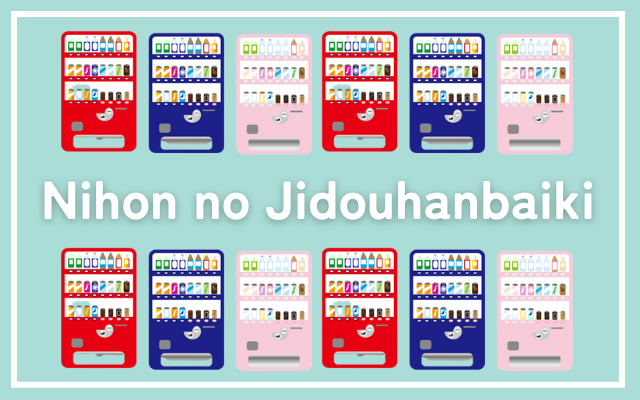
When foreigners come to Japan, they are surprised at the number of vending machines. They will be surprised at how easily they can find vending machines in their daily lives. In Japan, vending machines are available anytime, anywhere, and whenever you want. There is no need to look around for a store just because you are thirsty. You can find a vending machine in no time. Isn't that convenient? In this article, I would like to introduce the convenient and useful vending machines in Japan. Convenience of vending machines Vending machines have become an important part of Japanese life. They are so familiar to us that we don't even realize how much we appreciate them when we live in Japan. Once you try using a vending machine, you will fall in love with its convenience. Easy to find vending machines Vending machines can be found throughout the city, on the streets, inside buildings, and beside the entrances to convenience stores. Even in rural towns without stores, vending machines can always be found. They can be found not only in downtown areas, such as in front of train stations but also in residential areas, allowing people to purchase drinks whenever they need them. Lots of different kinds of drinks Water, tea, juice, sports drinks, and coffee are the most common drinks sold in vending machines. Some machines have an assortment of corn soup, oshiruko (Japanese sweet red bean soup), and amazake (sweet sake), which is a good drink to have when it is cold. Most vending machines are managed by beverage manufacturers. So the types of drinks sold and their prices vary by a vending machine. Sometimes rare drinks that are not sold in convenience stores or supermarkets are sold. Finding your favorite beverage is part of the fun too. You can choose between cold and hot drinks What makes Japanese vending machines excellent is that cold drinks are properly refrigerated. If you are thirsty on a hot summer day, you can get a cold drink as expected. On a cold winter day, you might want a hot drink. Hot beverages such as tea, coffee, and soup are available too. The availability of cold and hot beverages from a single vending machine is a wonderful example of Japanese technology. Accepts cash as well as electronic money Cashless vending machines are spreading in urban areas. Although it varies from vending machine to vending machine, an increasing number of machines accept transportation-related electronic money such as Suica, and distribution-related electronic money such as Nanaco, WAON, and Rakuten Edy. At Narita and Haneda airports, there are vending machines that accept credit cards. It is possible that your first purchase upon arrival in Japan was a drink from a vending machine. Please note that some vending machines in rural areas only accept cash! Items sold in vending machines Beverages are not the only things sold in Japanese vending machines. There are many different types of vending machines. They range from the most common to the most unique. Some local stores have vending machines that sell unique local delicacies, so if you see one, why not give it a try? Ice cream Breads, pastries Cakes Cigarettes Beer Frozen dumplings Local gourmet Fresh flowers Let's talk about vending machines and drinks at Ohanashi Kagawa!
Ohanasi Kagawa


Popular Articles
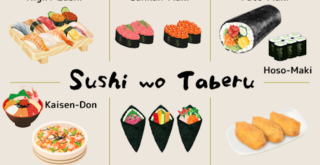
- Learn About the Different Types of Sushi and Enjoy Sushi Even More!
Sushi is always one of the top three things foreigners want to eat when the...
- What languages are spoken in Japan? If you want to study Japanese! Types, official language, and second language.
If you are interested in Japan, the first thing you will probably wonder ab...
- Ohanasi Kagawa Event Participation Instructions
In this page, we will tell you how to participate in the Ohanasi Kagawa lan...